


How to Become a Case Manager in California: Key Steps (2026)
Key takeaways
- California does not issue a general case manager license, so education and experience requirements depend on the employer, setting, and responsibilities of the position.
- Many case management roles require or prefer a bachelor’s degree in a field such as psychology, social work, human services, or another relevant area, while some entry-level support roles have lower education requirements.
- Case managers who provide regulated services must hold the credentials required for that work, such as an RN license for nursing practice or the appropriate professional license for clinical services.
- National credentials such as the Certified Case Manager (CCM) are voluntary and generally require qualifying education or licensure plus case management experience before you can apply.
Case management in California is defined more by the setting and responsibilities of the job than by a single state credential. Case managers coordinate services, resources, and care plans in healthcare, behavioral health, social services, developmental services, and other community settings, but the qualifications employers expect vary across those areas.
For adult learners, career changers, and working professionals considering this field, the sections below explain the education and experience that can prepare you for case management, the California roles that carry additional credential requirements, and the certifications and graduate education that may support later career progression.
How to become a case manager in California in 5 steps
There is no single route into case management in California. Many roles require or prefer a bachelor’s degree, while others are accessible with less formal education and relevant experience. Your next steps depend on the setting you want to work in, the services you provide, and any professional credentials attached to that role.
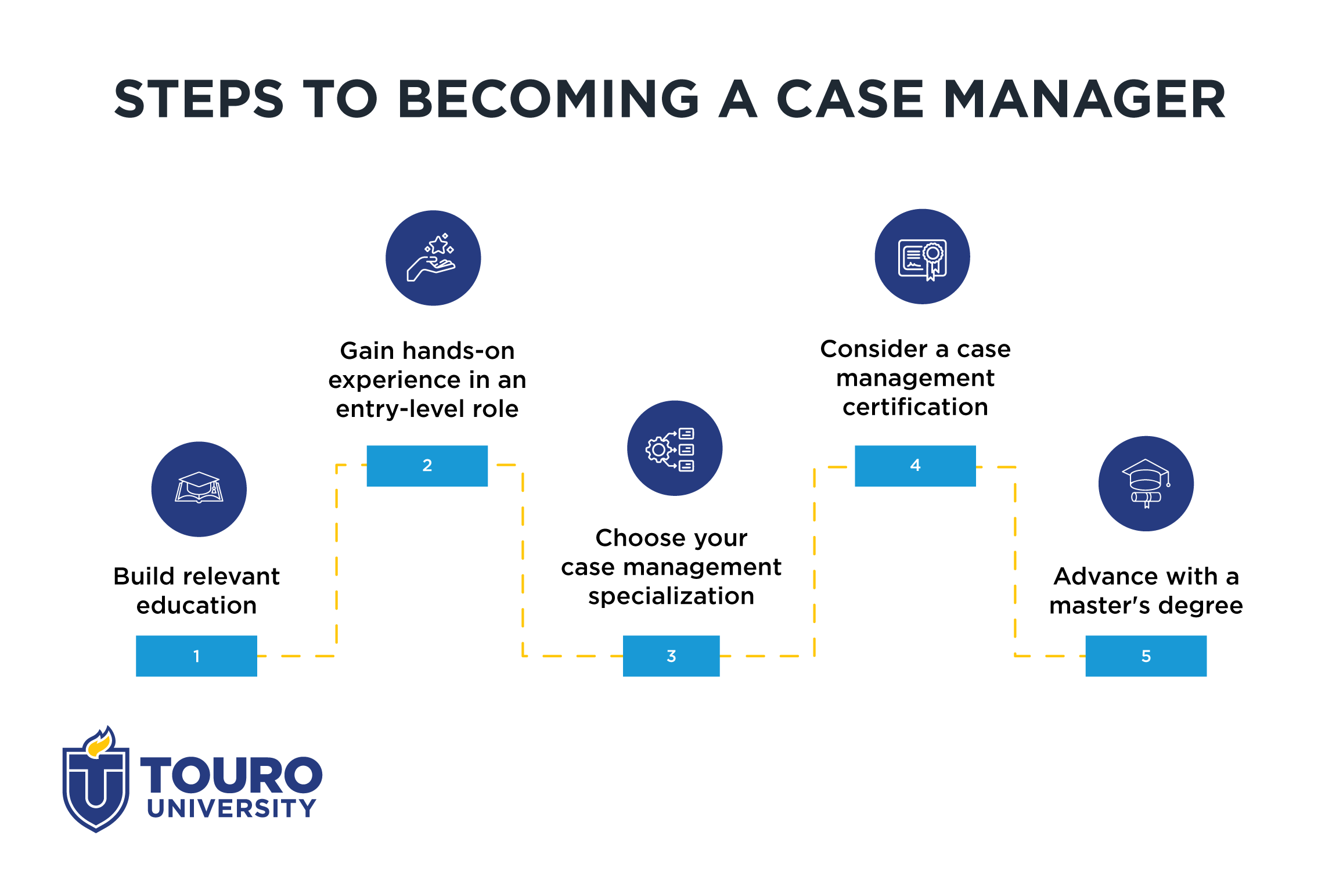
Step 1: Build relevant education
Many case management positions look for a bachelor’s degree in a field such as psychology, social work, human services, sociology, or another related area. Healthcare case management may also require a professional background such as nursing, depending on the position. Because employers set their own education requirements, review current job postings in your target setting before choosing a degree.
At TUW, our 100% online BA in Psychology with a Human Services concentration prepares students for work across human services, mental health, healthcare, and community settings. Our Bachelor of Arts in Social Work combines online coursework with required field education and prepares students for entry-level social work and human services roles.
Step 2: Gain hands-on experience in an entry-level role
Case management experience can begin in support and coordination roles before your job title formally includes “case manager.” Depending on the setting, relevant positions may include social and human service assistant, care coordinator, intake specialist, community health worker, residential support roles, or internships and field placements completed during a degree program.
California also uses several job titles that involve substantial case management responsibilities. Under Medi-Cal Enhanced Care Management, a Lead Care Manager coordinates health and health-related services for eligible members with complex needs. California’s 21 regional centers also assign eligible individuals a service coordinator who helps identify needs and connect them with services and resources.
Step 3: Choose your case management specialization
Case management looks different depending on the population and setting you serve. In California, opportunities include hospital and health plan case management, Medi-Cal Enhanced Care Management, county social and human services, behavioral health and substance use programs, developmental services through regional centers, aging services, and corrections or reentry programs.
Your choice of setting can affect the education, experience, and professional credentials employers expect. Healthcare roles, for example, may require an RN or social work background, while clinical or substance use services can carry separate California credential requirements.

Step 4: Consider a case management certification
National case management certifications are voluntary, but they can demonstrate additional professional preparation once you have gained qualifying experience. Two credentials relevant to healthcare and human services professionals are the Certified Case Manager (CCM) and Accredited Case Manager (ACM).
The Certified Case Manager (CCM) requires qualifying professional licensure or education plus relevant case management employment. One eligibility route requires 12 months of full-time case management experience under the supervision of a CCM, while another requires 24 months of qualifying full-time experience without CCM supervision.
The Accredited Case Manager (ACM) is designed specifically for registered nurses and social workers working in health delivery systems. Applicants need qualifying nursing licensure or social work education or licensure and at least 2,080 hours of paid case management experience. Internship experience does not count toward this requirement.
Step 5: Advance with a master’s degree
A master’s degree may support progression into clinical practice, program leadership, or other advanced roles, depending on your career goals. It is not a universal requirement for advancement in case management, so the right graduate degree depends on the type of work you want to pursue.
For example, California’s LCSW pathway requires a qualifying Master of Social Work, registration as an Associate Clinical Social Worker, 3,000 hours of supervised experience over at least 104 weeks, and the required licensing examinations. LMFT and LPCC applicants follow their own graduate education, associate registration, supervised experience, and examination requirements through the California Board of Behavioral Sciences.
For professionals interested in non-clinical leadership, our online Master of Science in Human Services develops knowledge for leadership across human services organizations. The 36-credit program is 100% online, uses eight-week courses, and offers six start dates per year. It does not lead to professional licensure or certification. Tuition is $500 per semester credit, and students can also review available financial aid options.
Do you need a license to be a case manager in California?

No. California does not issue a general license or certification for the job title “case manager.” However, some roles involve regulated services that require a separate professional license, registration, or credential.
Substance use counseling
Non-licensed or non-certified individuals who provide counseling services in qualifying substance use disorder programs must register with a DHCS-approved certifying organization and become certified within five years.
For first-time counselors registering on or after January 1, 2026, AB 2473 requires at least 80 hours of approved education within six months of registration. Those hours count toward the 315 hours required for initial certification.
Clinical mental health services
Case management itself does not require a mental health license. However, providing regulated clinical services requires the appropriate professional credential. In California, this may include licensure as an LCSW, LMFT, or LPCC through the Board of Behavioral Sciences, depending on the services provided.
Nurse case management
Case managers whose duties involve professional nursing practice must hold the nursing license required for that work. Nurse case management positions therefore commonly require an active RN license.
School-based case management
Credential requirements depend on the duties involved. The California Commission on Teacher Credentialing states that special education case managers who provide instruction or support services must hold the appropriate credential, while coordinators may be subject to different requirements.
How long does it take to become a case manager in California?
The timeline depends on the type of case management role you want and the education or credentials it requires. Many bachelor’s-level positions take about four years of full-time study to prepare for, while some entry-level support roles may be accessible sooner. Relevant work experience can also be required or preferred before moving into more advanced case management positions.
Professional credentials add their own timelines. For example, certain Certified Case Manager (CCM) eligibility routes require 12 months of qualifying full-time case management experience under CCM supervision or 24 months without it. California substance use counselors follow a separate registration and certification process, while clinical careers such as LCSW, LMFT, and LPCC require qualifying graduate education, supervised experience, and licensing examinations.
Career changers who already have relevant education or experience may be able to move into case management more quickly by targeting roles that match their existing background. TUW offers eight-week terms and six start dates each year, giving working students several opportunities to begin or continue their education throughout the year.

How much do case managers earn in California?
Because the Bureau of Labor Statistics does not track “case manager” as a single occupation, salary varies considerably by setting, responsibilities, and professional background. For the case manager title specifically, average annual pay in California is currently estimated at about $47,100, with most reported salaries falling between approximately $40,000 and $51,000. These figures are based on job postings and third-party salary data, so they are best used as a current market reference.
BLS data provide additional benchmarks for related roles. Social and human service assistants earn a median annual wage of $45,930, while social and community service managers earn $80,390. For case managers working as registered nurses, the national RN median was $97,550.
Employment prospects also differ by occupation. From 2025 to 2035, the BLS projects employment to grow 7% for social and human service assistants, 7% for social and community service managers, and 6% for registered nurses. These related occupations illustrate how case management opportunities can differ across social services, management, and healthcare.
Skills successful case managers need
Successful case managers need a mix of people skills and practical coordination abilities, since the role often involves balancing client needs with the requirements of healthcare providers, social service agencies, and other organizations.
- Active listening and assessment: Case managers need to understand a client’s circumstances, priorities, and barriers before identifying appropriate services or next steps.
- Service coordination: The work often involves communicating with multiple providers and agencies, following up on referrals, and helping clients move between different services.
- Documentation and time management: Accurate records, timely updates, and consistent follow-up are essential when managing multiple clients and ongoing care plans.
- Advocacy: Case managers often help clients understand available services, complete required processes, and communicate their needs within complex systems.
- Resource knowledge: Strong case managers know how to identify relevant healthcare, housing, behavioral health, financial, and community resources and connect clients with the options that fit their circumstances.
The bottom line
There is no single route to becoming a case manager in California. Education and experience requirements depend on the setting and responsibilities of the position, while roles involving nursing, clinical mental health services, substance use counseling, or other regulated work may require additional professional credentials.
Touro University Worldwide is a nonprofit university accredited by the WASC Senior College and University Commission (WSCUC) and offers programs for students preparing for careers across human and social services. Explore our BA in Psychology with a Human Services concentration, Bachelor of Arts in Social Work, or Master of Science in Human Services based on your career goals. You can also review our case manager career paths or connect with admissions for more information.
Frequently asked questions (FAQs)
What is the difference between a case manager and a social worker?
Case management is a function focused on coordinating services and resources, and professionals from several backgrounds may perform it. Social work is a professional field with its own education and practice standards. In California, an LCSW is a licensed clinical social worker who has completed graduate education, supervised experience, and licensing examinations and may provide clinical social work services within the scope of that license.
How do you become a nurse case manager?
Nurse case managers generally begin by qualifying and becoming licensed as registered nurses, then gaining relevant nursing and case management experience. Some later pursue a professional case management credential such as the Certified Case Manager (CCM) once they meet its education or licensure and employment-experience requirements.
Is case management a stressful job?
Case management can be demanding because the work may involve multiple clients, extensive documentation, deadlines, and people facing complex circumstances. The level of stress varies considerably by setting, caseload, population, and employer support.
How do case managers advance their careers and income?
Advancement may come through additional experience, specialization, professional certification, or further education. Some case managers move into supervisory or program-management positions, while others pursue graduate education and professional licensure for clinical careers. The best option depends on the type of case management work you want to pursue.