


How to Become a Victim Advocate in California: Steps and Pay
Key takeaways
- California does not issue a general victim advocate license, and education and hiring requirements vary by employer and role.
- Some victim advocacy positions, including certain sexual assault and domestic violence counselor roles, have specific training requirements under California law.
- Under Evidence Code §1037.1, domestic violence counselors must complete at least 40 hours of specified training. Evidence Code §1035.2 also includes a 40-hour training pathway for qualifying sexual assault counselors, alongside other eligibility routes.
Becoming a victim advocate in California does not follow a single state-mandated path. Employers set their own education and experience requirements, while California law establishes additional qualifications for certain roles, including sexual assault and domestic violence counselors.
For students, career changers, and working adults interested in supporting crime survivors, this step-by-step career path explains the education, experience, training, and optional credentials that may apply when becoming a victim advocate in California.
What does a victim advocate do?
Victim advocates support people affected by crime, including domestic violence, sexual assault, child abuse, homicide, fraud, and other offenses, as they access services and move through the justice system. Their responsibilities may include:
- Providing crisis intervention and emotional support
- Explaining victims’ rights and the court process
- Accompanying survivors to court proceedings, medical exams, or law enforcement interviews
- Helping with safety planning and protective-order resources
- Connecting survivors with compensation, housing, counseling, and other services
In California, many of the rights advocates help survivors understand are established under Marsy’s Law, which amended Article I, Section 28 of the California Constitution. Advocates may also help victims apply for compensation through the California Victim Compensation Board. Victim advocacy itself does not authorize clinical therapy, so advocates who are not separately licensed clinicians refer survivors to appropriate mental health professionals when clinical treatment is needed.
How to become a victim advocate in California: Step by step
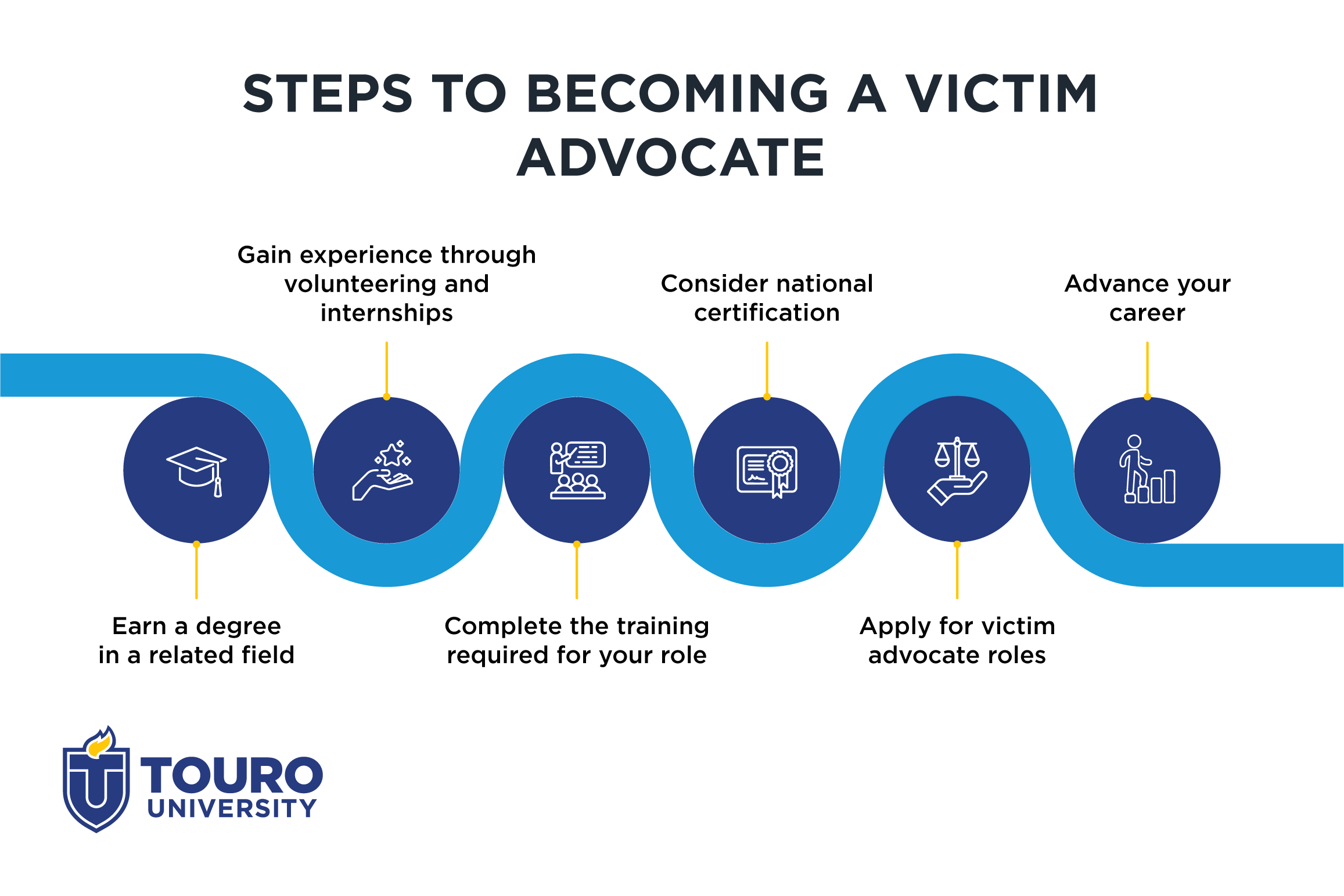
The path to becoming a victim advocate in California can include earning a degree in a related field, gaining hands-on experience through volunteering or internships, completing any training required for your role, and considering voluntary national certification. California does not issue a general victim advocate license, so education and hiring requirements vary by employer. Certain sexual assault and domestic violence counselor roles have specific training requirements under state law, which we cover in Step 3.
Step 1: Earn a degree in a related field
California does not require a specific degree for all victim advocate positions, but some employers prefer or require an associate or bachelor’s degree. Relevant fields include psychology, social work, criminal justice, sociology, and human services, depending on the type of advocacy work you want to pursue. The Bureau of Labor Statistics (BLS) notes that education requirements vary across related social and human service roles, with some employers preferring an associate or bachelor’s degree in human services or a related field.
Students can build relevant skills through several TUW programs. Our BA in Psychology with a Human Services concentration covers psychology and human services, while our Bachelor of Arts in Social Work develops skills in areas such as advocacy, referrals, and social services. Students interested in the justice-system side of advocacy can consider our BSBA with a Criminal Justice concentration, which includes coursework in criminal justice systems and procedures. The Psychology and BSBA programs are 100% online with no residency requirement, while the Social Work program combines online coursework with required field education.
Step 2: Gain experience through volunteering and internships
Hands-on experience can help you prepare for victim advocate roles and understand how survivor services work in practice. Opportunities may include volunteering with crisis hotlines, domestic violence organizations, or rape crisis centers, as well as internships with victim/witness programs, courts, or district attorneys’ offices. Experience in case management, social services, and related support roles can also be relevant.
For some sexual assault and domestic violence programs, volunteer preparation includes the specialized training required for direct survivor-support roles. Completing this training while volunteering can help you build relevant experience alongside your education.
Step 3: Complete the training required for your role
California does not require one training program for every victim advocate. However, state law establishes specific qualifications for certain sexual assault and domestic violence counselor roles.
Under Evidence Code §1037.1, a domestic violence counselor working for a qualifying victim service organization must complete at least 40 hours of supervised training covering areas such as domestic violence law, confidentiality and privilege, peer counseling, financial resources, and referral services.
The requirements for sexual assault counselors under Evidence Code §1035.2 depend on the counselor’s qualifications and setting. One pathway requires 40 hours of specified training under supervision, while the law also recognizes certain psychotherapists, people with relevant master’s degrees, and counselors with qualifying experience. For staff and prospective volunteers at Cal OES-funded rape crisis centers, Cal OES standards require at least 40 hours of sexual assault training before direct interaction with survivors.
These qualifications also matter for confidentiality. California provides a counselor-victim privilege for certain confidential communications between survivors and qualifying sexual assault counselors or domestic violence counselors. The privilege belongs to the victim, and completing a training course alone does not automatically make every victim advocate eligible for it.
Organizations such as ValorUS and the California Partnership to End Domestic Violence provide training standards, curricula, and other resources for sexual assault and domestic violence advocacy.
Step 4: Consider national certification
National certification is optional for most victim advocate roles in California. The National Organization for Victim Assistance (NOVA) offers the National Advocate Credentialing Program (NACP), with Provisional, Basic, Intermediate, and Advanced levels based largely on verified direct-service experience.
From November 1, 2025, all new NACP applicants must complete a pre-approved introductory advocacy training of at least 40 hours. A California sexual assault or domestic violence training counts toward this requirement only if the specific program is on NOVA’s pre-approved list.
Military victim advocacy has separate requirements. DoD Sexual Assault Prevention and Response Victim Advocates (SAPR VAs) must hold Defense Sexual Assault Advocate Certification Program (D-SAACP) certification, which includes at least 40 hours of initial training and continuing education for renewal.
Step 5: Apply for victim advocate roles
Hiring requirements vary by employer, so focus your application on relevant education, direct-service experience, crisis support, and any specialized training you have completed. Government and law enforcement positions may also include background screening or other agency-specific requirements.
Look for titles such as victim advocate, victim/witness advocate, victim services specialist, and victim/witness coordinator. California’s Victim/Witness Assistance Program maintains centers in all 58 counties under Penal Code §13835. These centers provide services such as crisis intervention, court support, compensation assistance, referrals, and restitution assistance, and may operate through district attorney’s offices, probation departments, sheriff’s offices, or community organizations.
Step 6: Advance your career
With experience, victim advocates may move into senior advocacy, program coordination, management, or specialized victim-services roles. Federal opportunities may have additional education and experience requirements. For example, most FBI victim services positions require at least a bachelor’s degree in a social or behavioral science field and relevant direct-service experience.
If you want to prepare for leadership in human services, our online Master of Science in Human Services develops skills in management, nonprofit organizations, public policy, and program development and evaluation. The 36-credit program is 100% online and is designed for professionals working across nonprofit, public, government, and other human services settings.
Where victim advocates work: Employer types compared
Victim advocates work across community organizations, justice-system agencies, and federal or military programs. The setting influences who you support, how closely you work with the legal system, and the types of services you provide.
| Employer type | Where you work | What the work emphasizes |
|---|---|---|
| Community-based | Nonprofits, domestic violence organizations, rape crisis centers, and other victim service organizations | Crisis support, safety planning, referrals, and help accessing community resources |
| System-based | Police and sheriff’s departments, prosecutors’ offices, courts, and victim/witness assistance programs | Victims’ rights, court support, compensation and restitution assistance, and help understanding the justice process |
| Federal and military | Federal agencies and military victim advocacy programs | Support for victims of federal or military-related crimes, crisis response, referrals, and coordination with other agencies |
Community-based roles generally place more emphasis on immediate support and access to services, while system-based roles involve more direct interaction with courts, law enforcement, and the criminal justice process. Federal and military positions apply many of the same advocacy skills within their own systems and requirements.
How long does it take to become a victim advocate in California?
There is no single timeline for becoming a victim advocate in California because education, experience, and training requirements vary by employer and role. If you pursue a bachelor’s degree, it typically takes about four years of full-time study. Certain sexual assault and domestic violence counselor roles also require at least 40 hours of specialized training.
Students may be able to gain relevant volunteer or internship experience while completing their degree, while career changers who already have relevant education or experience may qualify for some roles sooner. The timeline ultimately depends on the position and any specialized training the employer or California law requires.
At TUW, eight-week terms and six start dates each year give students several opportunities to begin throughout the year. Our BA in Psychology with a Human Services concentration also offers an accelerated admissions process and accepts up to 90 eligible transfer credits.
Victim advocate salary and job outlook in California

BLS does not track victim advocates as a separate occupation, so one useful benchmark is social and human service assistants, a broader category that includes similar client-support work. According to the latest BLS wage data, social and human service assistants in California earned a median annual wage of $51,090 and a mean annual wage of $55,100.
For the victim advocate title specifically, average annual pay in California is estimated at about $60,000. Most reported salaries fall between approximately $52,000 and $68,000, representing the 25th and 75th percentiles. Because these figures are based on job postings and third-party salary data, they are best treated as a current market reference.
BLS projects employment of social and human service assistants to grow 7% from 2025 to 2035, with about 48,900 openings projected each year. Actual victim advocate pay varies by employer, location, experience, responsibilities, and the type of advocacy work involved.
The bottom line
There is no single state-mandated path to becoming a victim advocate in California. Education and experience requirements vary by employer, while certain sexual assault and domestic violence counselor roles require specialized training under California law. Voluntary credentials such as NACP can provide additional professional recognition.
If you want to build an academic foundation for work in victim services and related human services fields, explore our BA in Psychology with a Human Services concentration or Bachelor of Arts in Social Work. You can also connect with admissions to request information or begin an application.
Frequently asked questions (FAQs)
What certification do victim advocates need?
There is no single certification required for all victim advocates in California. Certain sexual assault and domestic violence counselor roles have specific training requirements under state law, while the National Advocate Credentialing Program is a voluntary professional credential. Military SAPR Victim Advocates have separate D-SAACP requirements.
How do you become a domestic violence advocate?
Requirements vary by employer and role. To qualify as a domestic violence counselor under California Evidence Code §1037.1, you must work for a qualifying domestic violence victim service organization and complete at least 40 hours of specified training.
Can I become a victim advocate with an online degree?
Yes, provided the degree meets the education requirements of the position you are pursuing. Employers may also consider relevant experience and role-specific training, so check the qualifications listed for individual victim advocate positions.
Is being a victim advocate worth it?
That depends on your career goals, salary expectations, and interest in supporting people affected by crime. For people genuinely drawn to survivor-focused work, victim advocacy can offer a meaningful career across community organizations, justice-system agencies, and public service settings. BLS also projects employment of social and human service assistants, a related occupational category, to grow 7% from 2025 to 2035.
What is a victim witness advocate in California?
A victim/witness advocate works within the justice system to help crime victims understand their rights, access services, and move through the legal process. California’s Victim/Witness Assistance Program includes services such as crisis intervention, court support, compensation assistance, referrals, and restitution assistance.