


How to Become a Grief Counselor in California: Degree Path
Key takeaways
- California does not issue a separate license for grief counselors. Professionals who provide clinical grief counseling typically do so under a mental health license, with grief-specific education or training added to their broader clinical preparation.
- The California path to becoming a grief counselor generally includes a bachelor’s degree, a qualifying clinical master’s degree in an area such as counseling, marriage and family therapy, or social work, and licensure through the appropriate state board.
- Since AB 462 took effect on January 1, 2022, California LPCCs can assess and treat couples and families without completing the additional education and supervised experience previously required for this scope of practice.
- Grief-focused training or certification can help licensed professionals develop specialized knowledge in bereavement, death, and loss, but it does not replace the education, supervised experience, and examinations required for clinical licensure.
Learning how to become a grief counselor in California starts with understanding the difference between professional licensure and grief specialization. California does not offer a separate grief counselor license. Instead, professionals who provide clinical grief counseling typically qualify through an established mental health profession, such as professional clinical counseling, marriage and family therapy, or clinical social work, and then develop expertise in grief and bereavement.
The California Board of Behavioral Sciences regulates LPCCs, LMFTs, and LCSWs and sets the education, supervised experience, and examination requirements for these licenses. Professional organizations such as the Association for Death Education and Counseling (ADEC) offer voluntary credentials for professionals who want additional recognition of their education and experience in death, dying, and bereavement.
How to become a grief counselor in California: Step by step
The path to providing clinical grief counseling in California generally involves earning a bachelor’s degree, completing a qualifying clinical master’s degree, registering with the California Board of Behavioral Sciences (BBS) as an associate, completing the required supervised experience, and passing the examinations required for your license. You can then build additional expertise in grief and bereavement through relevant training, clinical experience, or voluntary certification.
Licensure requirements vary by state, including the education, supervised experience, and examinations required. If you plan to move into or out of California, check the requirements with the licensing board in the state where you intend to practice.
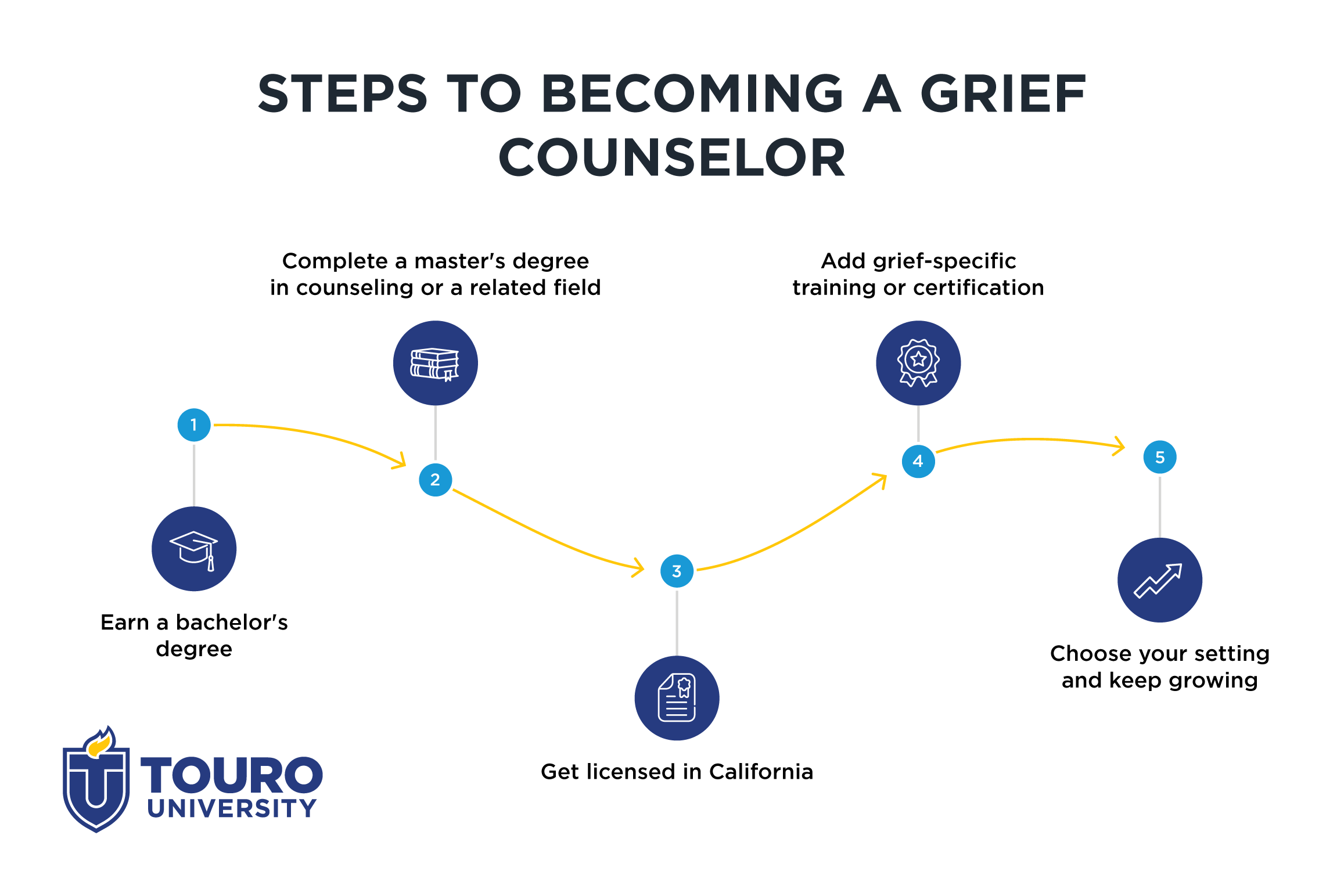
Step 1: Earn a bachelor’s degree
A bachelor’s degree provides the academic foundation for graduate clinical study. Requirements vary by graduate program, so prospective students should check the admissions criteria for the master’s degree they plan to pursue. Psychology, human services, social work, and related fields can provide relevant preparation for later study in counseling and behavioral health.
You may also look for opportunities to gain early exposure to grief and bereavement support through hospice programs, crisis services, or community organizations. This experience can help you better understand the populations and settings involved in grief-related work before beginning clinical training.
Students starting their education at TUW may consider the Bachelor of Arts in Psychology with a concentration in Human Services. The program covers psychology and human services and is designed to provide a foundation for graduate study in areas including counseling and social work.
Step 2: Complete a master’s degree in counseling or a related field
Your graduate degree should align with the California license you plan to pursue. A qualifying master’s degree in counseling can lead toward Licensed Professional Clinical Counselor (LPCC) licensure, while a qualifying marriage and family therapy degree can lead toward Licensed Marriage and Family Therapist (LMFT) licensure. A master’s degree in social work from an accredited school of social work provides the educational foundation for the Licensed Clinical Social Worker (LCSW) pathway. Professionals with any of these licenses may develop expertise in grief and bereavement within their education, training, and scope of competence.
California LPCCs can also work with couples and families. Since January 1, 2022, they no longer have to complete the additional education, 500 hours of supervised experience with couples, families, or children, or marriage and family therapy continuing education that California previously required for this work. LPCCs must still practice within their scope of competence based on their education, training, and experience.
When comparing graduate programs, confirm that the curriculum meets the educational requirements for the California license you plan to pursue and includes the required clinical training. You can also look for coursework relevant to grief-focused practice, such as trauma, crisis intervention, or human development.
Our online Master of Arts in Counseling includes a required Addiction Counseling specialization. Students planning to pursue LPCC licensure in California must select the 72-credit Advanced Topics Track, which is approved by the California Board of Behavioral Sciences for the program’s educational requirements and includes 700 hours of practicum and internship training. The Advanced Topics curriculum also includes Crisis/Trauma Response and Interventions, which addresses prolonged grief issues.
Students interested in the LMFT pathway can explore our online Master of Arts in Marriage and Family Therapy and should select a track that meets California BBS requirements for their intended license.
Step 3: Get licensed in California
After completing a qualifying graduate degree, you generally register with the California Board of Behavioral Sciences (BBS) as an associate while completing the supervised experience required for licensure. The associate registration depends on your pathway: Associate Professional Clinical Counselor (APCC) for LPCC licensure, Associate Marriage and Family Therapist (AMFT) for LMFT licensure, or Associate Clinical Social Worker (ASW) for LCSW licensure.
California requires associates to take the Law and Ethics Examination for their license type and complete the required supervised experience. After meeting the licensure requirements and receiving BBS approval, applicants must also pass the applicable clinical examination. Grief-focused clinical placements, such as hospice, oncology, or palliative care settings, may provide relevant experience while you work toward licensure.

Step 4: Add grief-specific training or certification
Once you have established the clinical foundation for your chosen profession, you can develop additional expertise in grief and bereavement. Options include continuing education in grief and loss, study in thanatology, which focuses on death and dying, and voluntary professional certifications such as those discussed below.
Grief-specific education can deepen your understanding of bereavement, grief-related assessment and intervention, and topics such as prolonged grief. It does not expand the legal scope of your underlying professional license or replace California licensure requirements. If you plan to use a grief course toward your continuing education requirements, confirm that the course and provider meet California BBS requirements before enrolling.
Step 5: Choose your setting and keep growing
Grief-focused professionals may work in settings such as hospices, hospitals and health systems, community mental health organizations, schools and universities, faith-based or community organizations, and private practice, depending on their license, role, and scope of competence. Hospice is particularly relevant to grief and bereavement work because Medicare-certified hospices must maintain an organized bereavement program and make bereavement services available to eligible family members and others identified in the bereavement plan of care for up to one year after a patient’s death.
California LMFTs, LCSWs, and LPCCs must complete 36 hours of continuing education during each renewal period, including six hours of law and ethics. Voluntary grief certifications may have separate renewal or continuing education requirements, so check the requirements of the organization that issued your credential.
Grief counseling certifications: What they add and what they don’t
A state-issued mental health license authorizes clinical practice within the scope of that license. A grief certification or certificate provides additional education or professional recognition in grief and bereavement, but it does not replace the license required for clinical practice in California.
| Credential | Certifying body | Who it’s for | What it adds |
|---|---|---|---|
| Certified Grief Counselor GC-C | American Academy of Grief Counseling (AAGC), part of AIHCP | Counselors, social workers, nurses, psychologists, physicians, clergy, funeral directors, and other applicants who meet the organization’s professional or educational prerequisites | Requires at least 100 hours of approved education in grief counseling and bereavement. It is a voluntary professional certification, not a state license. |
| Certified in Thanatology CT | Association for Death Education and Counseling (ADEC) | Applicants who meet one of ADEC’s eligibility tracks based on education or professional licensure, documented experience in thanatology, and prior thanatology education | A foundational thanatology certification that requires documented experience, 90 contact hours of relevant education, and a passing certification exam. ADEC states that the credential does not constitute licensure or establish clinical competency. |
| Certified Grief-Informed Professional CGP | Evergreen Certifications | Eligible licensed or credentialed professionals, associate or provisionally licensed mental health professionals, and graduate students in clinical mental health programs who are practicing under supervision | Requires at least six hours of qualifying grief-focused continuing education. The certification does not expand the holder’s professional scope of practice. |
| Grief Educator Certification | David Kessler / Grief.com | Coaches, educators, volunteers, and clinicians who want grief education skills | Provides training in grief education and support. Grief.com states that completing the program does not certify professional competence, and the credential does not itself authorize clinical diagnosis or treatment. |
The right credential depends on your existing qualifications and the type of grief-related work you plan to do. For licensed clinicians, specialty education can supplement the training and experience behind their professional license. For people who are still preparing for clinical practice, these credentials do not replace the graduate education, supervised experience, examinations, and licensure required in California.
California licensees who want a grief course to count toward their continuing education requirements should also confirm that the course and provider meet BBS requirements before enrolling.
Our online Master of Arts in Counseling provides the graduate preparation required for students pursuing the appropriate counseling pathway. The 72-credit Advanced Topics Track includes Crisis/Trauma Response and Interventions, which covers prolonged grief issues. Students who want to develop a deeper grief specialization can pursue additional training and professional credentials as they progress in their careers.
How long does it take to become a grief counselor?
The timeline depends on your education, license pathway, and how quickly you complete the required supervised experience. For the California LPCC route, someone starting with no college education should generally plan on about eight years or more to reach full licensure. Someone who already holds a bachelor’s degree may need about four years or more.
A typical timeline includes:
- Bachelor’s degree: about 4 years
- Qualifying master’s degree: often about 2 to 3 years, depending on the program and course load
- Post-degree supervised experience: at least 2 years for the LPCC route, since California requires 3,000 supervised hours over a minimum of 104 weeks
- Grief-specific training: optional and may be completed during or after your clinical training, depending on the program or credential
These stages do not always have to occur completely separately. Students may begin developing grief-related knowledge through relevant coursework or clinical experiences while completing their degree and supervised training. Our eight-week online sessions and six start dates each year give students several opportunities to begin throughout the year.

How much do grief counselors earn in California?
The Bureau of Labor Statistics (BLS) does not track grief counselors as a separate occupation, so earnings depend largely on the professional license and role under which you provide grief counseling. Two relevant California benchmarks are substance abuse, behavioral disorder, and mental health counselors and marriage and family therapists.
According to the latest BLS wage data, substance abuse, behavioral disorder, and mental health counselors in California earned a median annual wage of $59,250 and a mean annual wage of $69,080. Marriage and family therapists in California earned a median of $67,300 and a mean of $79,440.
For jobs advertised specifically under the grief counselor title, the estimated average annual pay in California is around $62,000. Most salaries fall between $47,000 and $68,000, representing the 25th and 75th percentiles. These figures are best used as a current market reference instead of a definitive salary benchmark.
The broader counseling occupations also have strong national employment projections. BLS projects employment of substance abuse, behavioral disorder, and mental health counselors to grow 18% from 2025 to 2035, while employment of marriage and family therapists is projected to grow 14% over the same period.
Actual earnings vary by professional license, experience, location, employer, and practice setting. Grief specialization does not have a separate wage category in BLS data, so salary expectations are better based on the occupation and license under which you practice.

The bottom line
Becoming a clinical grief counselor in California starts with choosing a professional license pathway, completing the required graduate education and supervised experience, and meeting the examination requirements for that license. You can then develop expertise in grief and bereavement through relevant clinical experience, continuing education, or voluntary professional certification. Your license establishes the scope within which you can practice, while grief-specific education and experience develop your specialization.
If professional clinical counseling is the route you want to pursue, explore our online Master of Arts in Counseling at Touro University Worldwide, a nonprofit university accredited by the WASC Senior College and University Commission (WSCUC). When you are ready to take the next step, connect with admissions to request information or begin your application.
Frequently asked questions (FAQs)
Is a grief counselor the same as a therapist?
Not necessarily. California does not issue a separate grief counselor license. Professionals who provide clinical grief counseling may practice as LPCCs, LMFTs, LCSWs, or under another appropriate licensed profession, depending on their qualifications and scope of practice. The title “grief counselor” by itself does not establish that someone holds a particular clinical license.
What degree is best for becoming a grief counselor?
There is no single best degree because the right graduate program depends on the license you want to pursue. A qualifying counseling degree can support the LPCC pathway, a qualifying marriage and family therapy degree can support the LMFT pathway, and a master’s degree in social work from an accredited school of social work is required for the LCSW pathway. Each route can provide a foundation for developing expertise in grief and bereavement.
What’s the difference between a grief counselor and a bereavement counselor?
The job titles can overlap, and California does not license them as separate professions. The underlying concepts are slightly different: grief refers to the emotional response to loss, while bereavement refers to the period following the death of a loved one. In either case, the professional’s underlying license and scope of practice determine the clinical services they can provide.
Do I need a grief counseling certification to practice?
No. Grief certification is voluntary and does not replace the professional license required for clinical practice. If you plan to provide clinical counseling in California, you must meet the education, supervised experience, examination, and other requirements for the relevant professional license. Grief-specific certification or continuing education can provide additional training within that professional role.
Is becoming a grief counselor worth it?
That depends on the type of work you want to do and the time required to qualify for your chosen profession. Grief counseling can be incorporated into several mental health careers. For people genuinely drawn to this work, whether through professional interest or personal experience with loss, it can be a meaningful, in-demand specialty within an already strong-outlook field.