


How to Become a Therapist in California: Steps and Tips
Key takeaways
- Four common routes to providing therapy in California are LMFT, LPCC, LCSW, and licensed psychologist.
- The LMFT, LPCC, and LCSW routes require a qualifying graduate degree, associate registration, 3,000 supervised hours over at least 104 weeks, the California Law and Ethics Exam, approval of the licensure application, and a clinical exam.
- The California Board of Behavioral Sciences (BBS) regulates LMFTs, LPCCs, and LCSWs. Licensed psychologists follow a separate doctoral route through the California Board of Psychology.
- To count eligible hours earned before associate registration is issued, the BBS must receive the AMFT, APCC, or ASW application within 90 days of the degree award date. The workplace must also require Live Scan fingerprinting before those hours begin.
Becoming a therapist in California means choosing a license type and completing the education, supervised hours, and exams required by the state. This guide explains the main license options, degree requirements, timelines, and costs for aspiring therapists, career-changers, and working adults considering an online program. The California Board of Behavioral Sciences (BBS) governs most of this path, and we’ll point to its requirements throughout.
How to become a therapist in California (step-by-step)
For the LMFT, LPCC, and LCSW routes, you must earn a qualifying graduate degree, register as an associate with the California Board of Behavioral Sciences, and complete 3,000 supervised hours over at least 104 weeks. You must also pass the California Law and Ethics Exam, receive approval to take your clinical exam, pass that exam, and request your license.
The first six steps explain these three BBS-regulated routes. Licensed psychologists follow a separate process through the California Board of Psychology.
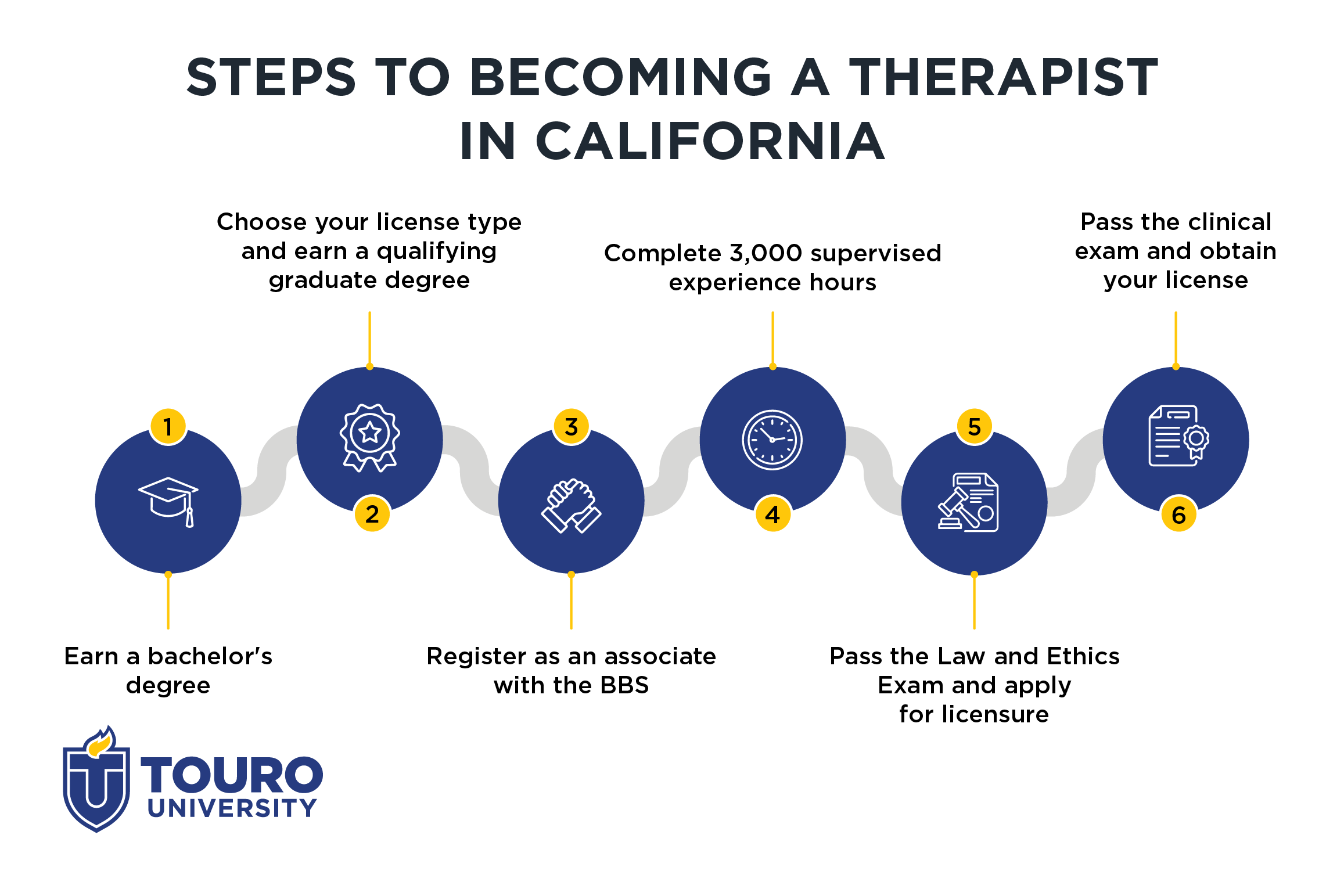
Step 1: Earn a bachelor’s degree
California does not require a specific undergraduate major for these therapy careers. Degrees in psychology, social work, human services, or a related field may provide useful preparation.
Graduate programs may require courses in subjects such as developmental psychology, statistics, or research methods, so check admission requirements early. Relevant internships or volunteer experience may also strengthen your application.
Step 2: Choose your license type and earn a qualifying graduate degree
Each license has different education requirements. LMFT candidates need a qualifying graduate degree in marriage and family therapy or a related field. LPCC candidates need a qualifying 60-semester-unit counseling degree, while LCSW candidates need a Master of Social Work from a program accredited by the Council on Social Work Education.
Choose a program that meets California’s requirements for your intended license. Otherwise, you may need additional coursework before you can register as an associate.
TUW’s online Master of Arts in Marriage and Family Therapy includes a BBS-approved Marriage and Family Therapy Track designed to meet California’s educational requirements for LMFT licensure. Students seeking educational eligibility for both LMFT and LPCC licensure may add the Counseling Licensure Track. Review the MFT curriculum and LPCC track and TUW’s state licensure requirements before selecting a plan of study, especially if you may practice outside California. Coursework is online, but the licensure tracks include supervised practicum requirements.
Students interested in the LPCC route with a focus on substance use may also explore TUW’s Online Master’s in Counseling, which offers an Addiction Counseling specialization. California students must complete the 72-credit Advanced Topics Track, which is approved by the BBS for the state.
Step 3: Register as an associate with the BBS
After graduation, you must register with the BBS before most post-degree hours can count. LMFT candidates register as AMFTs, LPCC candidates as APCCs, and LCSW candidates as ASWs. Registration requires fingerprint-based background checks through the California Department of Justice and the Federal Bureau of Investigation.
The BBS must receive your associate application within 90 days of your degree award date for hours earned during the waiting period to count. Your workplace must also require Live Scan fingerprinting before you begin those hours, and you must keep the completed form.
Step 4: Complete 3,000 supervised experience hours

LMFT, LPCC, and LCSW candidates must complete 3,000 supervised hours over at least 104 weeks. Keep detailed records of your hours, supervision, and activities throughout this period.
The requirements differ by license, including how many hours must involve direct clinical work, supervision, and other professional activities. Hours may be completed in settings such as community mental health agencies, nonprofit organizations, group practices, and hospitals.
TUW guides students through the practicum process with support from its program team and community placement liaison advisors. Students must find their own practicum site, which TUW must approve before the placement begins.
Step 5: Pass the Law and Ethics Exam and apply for licensure
Associates must take the California Law and Ethics Exam during each annual registration period until they pass it. After completing the required supervised hours and passing the exam, candidates submit their licensure application, transcripts, experience records, and fees to the BBS.
Step 6: Pass the clinical exam and obtain your license
Once the BBS approves the licensure application, candidates may take the clinical exam for their license type:
- LMFT: California LMFT Clinical Exam (BBS is working on switching to the National MFT
- exam, pending final approval, by July of 2027).
- LPCC: National Clinical Mental Health Counseling Examination
- LCSW: Association of Social Work Boards Clinical Exam
After passing, candidates must request initial license issuance and pay the required fee within one year. The BBS confirms that application approval comes before clinical-exam eligibility.
The Law and Ethics exams and the LMFT Clinical Exam are administered through Pearson VUE. The NCMHCE is administered by the National Board for Certified Counselors, while the LCSW Clinical Exam is administered by the Association of Social Work Boards. Check the BBS exam pages for current fees, eligibility rules, and scheduling instructions.
Separate route: Become a licensed psychologist
Licensed psychologists follow a separate process through the California Board of Psychology, not the BBS. They do not register as AMFTs, APCCs, or ASWs.
Applicants must earn a qualifying doctoral degree and complete 3,000 hours of supervised professional experience. At least 1,500 hours must be completed after meeting all requirements for the doctoral degree. They must also complete required prelicensure coursework, submit fingerprints for state and federal background checks, and pass two exams.
The licensing process has three main stages:
- Pass the EPPP: Applicants must document a qualifying doctoral degree and at least 1,500 supervised hours to become eligible.
- Pass the CPLEE: After passing the EPPP, applicants must document all 3,000 supervised hours, including at least 1,500 postdoctoral hours.
- Request the license: After passing the CPLEE and completing all outstanding requirements, applicants may request issuance of their psychologist license.
Therapist license types in California: LMFT, LPCC, LCSW, and licensed psychologist
“Therapist” is a broad term rather than a single professional title. The table below compares four common California license routes.
| Category | LMFT | LPCC | LCSW | Licensed psychologist |
|---|---|---|---|---|
| Full title | Licensed Marriage and Family Therapist | Licensed Professional Clinical Counselor | Licensed Clinical Social Worker | Licensed Psychologist |
| Degree required | Qualifying master’s or doctoral degree that meets California’s LMFT educational requirements | Qualifying master’s or doctoral degree that meets California’s LPCC educational requirements, including at least 60 semester units or 90 quarter units | Master of Social Work from a school accredited by the Council on Social Work Education | Qualifying doctoral degree that meets California Board of Psychology requirements |
| Governing board | California Board of Behavioral Sciences | California Board of Behavioral Sciences | California Board of Behavioral Sciences | California Board of Psychology |
| Prelicensed status | Registered Associate Marriage and Family Therapist (AMFT) | Registered Associate Professional Clinical Counselor (APCC) | Associate Clinical Social Worker (ASW) | No required associate registration; applicants follow the Board of Psychology’s supervised professional experience requirements |
| Supervised experience | 3,000 supervised hours over at least 104 weeks | 3,000 supervised hours over at least 104 weeks | 3,000 supervised hours over at least 104 weeks | 3,000 hours of supervised professional experience, including at least 1,500 postdoctoral hours |
| Required licensing exams | California LMFT Law and Ethics Exam and California LMFT Clinical Exam | California LPCC Law and Ethics Exam and National Clinical Mental Health Counseling Examination (NCMHCE) | California LCSW Law and Ethics Exam and Association of Social Work Boards Clinical Exam | Examination for Professional Practice in Psychology (EPPP) and California Psychology Laws and Ethics Examination (CPLEE) |
| Typical training emphasis | Relational and systems-based therapy with individuals, couples, and families | Mental health counseling and psychotherapy, often with individuals and groups | Clinical social work, psychotherapy, case management, advocacy, and resource coordination | Psychological assessment and testing, diagnosis, intervention, research, and psychotherapy |
The final row describes common areas of training, not exclusive limits on each profession’s work. All four professions may provide psychotherapy within their legal scopes.
How long does it take to become a therapist in California?
There is no fixed timeline. After earning a bachelor’s degree, LMFT, LPCC, and LCSW candidates must complete a qualifying graduate degree and 3,000 supervised hours over at least 104 weeks. The total time depends on the program, the license, and how quickly the candidate can earn the required hours.
The psychologist route may take longer because it requires a qualifying doctoral degree and 3,000 hours of supervised professional experience, including at least 1,500 postdoctoral hours.
Part-time students and career-changers may need more time, especially if they complete supervised hours while working elsewhere. TUW offers six start terms each year, with courses lasting eight weeks, so students do not have to wait for one annual intake to begin their studies.
How much does it cost to become a therapist in California?
The total cost varies by program and licensing path. Candidates must account for graduate tuition, fingerprinting, associate registration, licensing applications, the California Law and Ethics Exam, and the clinical exam required for their license. Licensed therapists must also pay renewal fees and complete continuing education.
California temporarily reduced many BBS fees by 50% from July 1, 2026, through June 30, 2030. During this period, the associate registration application costs $75, the California Law and Ethics Exam costs $75, the licensure application costs $125, and initial license issuance costs $100. The LMFT Clinical Exam costs $125. Fees for the LPCC and LCSW clinical exams are set separately by the organizations that administer them. Candidates should check the current BBS fee schedule before budgeting.
TUW’s Marriage and Family Therapy Track currently costs $525 per semester credit. The rate remains fixed for students who continue to be actively matriculated. Additional charges include a $25 application fee, a $116 material fee during the capstone course, and a $200 graduation fee. Scholarships and reduced tuition programs are available to eligible students. Review TUW’s affordable, locked-in tuition page for the latest tuition, fees, scholarships, and reduced tuition options.
Skills and qualities of a successful therapist

Education and supervised experience provide the clinical foundation for therapy work. Therapists also need strong interpersonal skills, sound judgment, and habits that support long-term professional practice.
- Empathy and active listening: Therapists must understand a client’s perspective, listen without rushing to conclusions, and respond in a way that helps the client feel heard.
- Clear communication: Therapists need to explain ideas clearly, ask useful questions, and adjust their communication style to suit different clients and situations.
- Cultural competence: Effective practice requires awareness of how culture, identity, family background, and life experience may influence a client’s needs and view of therapy.
- Ethical judgment and boundaries: Therapists must protect confidentiality, maintain professional boundaries, and make decisions that follow legal and ethical standards.
- Self-awareness and resilience: Therapists need to recognize their own reactions, manage the emotional demands of the work, and seek supervision or support when needed.
TUW’s MFT faculty includes licensed clinicians and AAMFT-approved supervisors who bring professional experience into the program.
Where therapists work: Settings and areas of focus in California
Therapists may work in private practice, community mental health centers, schools, hospitals, integrated healthcare settings, nonprofit organizations, and telehealth. The settings available depend on the therapist’s license, training, and employer.
Common areas of focus include:
- Trauma-informed care
- Children and adolescents
- Substance use and addiction
- Couples and family relationships
- Integrated behavioral health
National employment projections indicate continued demand across several mental health professions. The BLS projects employment growth from 2024 to 2034 of 13% for marriage and family therapists, 17% for substance abuse, behavioral disorder, and mental health counselors, 10% for mental health and substance abuse social workers, and 11% for clinical and counseling psychologists. TUW’s School of Behavioral and Applied Sciences and alumni network support graduates across many of these settings as they build their careers.
Tips to avoid licensing delays and common mistakes

Careful planning can help you avoid problems that delay associate registration, supervised experience, or final licensure.
- Check the program before enrolling: Confirm that it meets the education and accreditation requirements for your intended license.
- Apply within the 90-day window: Make sure the BBS receives your associate application within 90 days of your degree award date if you want eligible gap-period hours to count.
- Keep complete records: Save dated supervision logs, experience forms, and Live Scan documentation as you complete each requirement.
- Take the Law and Ethics Exam early: Do not wait until you have nearly completed your supervised hours.
- Choose a suitable supervision setting: Look for consistent access to clients, qualified supervision, and the types of experience required for your license.
- Prepare for the clinical exam in advance: Begin studying before your supervised hours are complete so you are ready once the BBS approves you to test.
The bottom line
Becoming a therapist in California requires graduate education, supervised experience, licensing exams, and careful attention to state requirements. LMFT, LPCC, and LCSW candidates follow the BBS process, while psychologists complete a separate doctoral licensing route.
TUW’s online Master of Arts in Marriage and Family Therapy prepares students for careers working with individuals, couples, and families. Explore the university’s admissions process, upcoming start dates, and scholarships available to eligible students.
Frequently asked questions (FAQs)
Can you become a therapist in California without a master’s degree?
Not with only a bachelor’s degree. LMFT, LPCC, and LCSW licensure require a qualifying graduate degree, while licensed psychologists need a qualifying doctoral degree. Some behavioral health support roles require less education, but they are not the same as licensed therapist roles.
Do you need a license to practice as a therapist in California?
Independent psychotherapy practice generally requires the appropriate California license. AMFTs, APCCs, and ASWs may provide psychotherapy while holding an active BBS registration and working under qualified supervision. Limited exceptions apply in certain exempt employment settings.
Professional titles such as LMFT, LPCC, and LCSW may be used only by people who hold the corresponding license.
Can I become a licensed therapist in California with an online master’s degree?
Yes. An online degree may qualify if it meets California’s educational and accreditation requirements for the intended license.
TUW’s online Marriage and Family Therapy Track is approved by the California BBS and is designed to meet the educational requirements for LMFT licensure. Students seeking educational eligibility for both LMFT and LPCC licensure may combine it with TUW’s Counseling Licensure Track.
What is the 90-day rule for California therapist licensing?
The BBS must receive your AMFT, APCC, or ASW application within 90 days of your degree award date for eligible hours earned before registration is issued to count. Your workplace must also require Live Scan fingerprinting before you begin those hours, and you must keep the completed form. If these conditions are not met, hours earned before registration is issued generally will not count.
Can I transfer an out-of-state therapist license to California?
California does not automatically transfer an out-of-state license. LMFT, LPCC, and LCSW applicants must apply through the BBS, which reviews their education, supervised experience, examinations, and licensing history. Additional coursework or examinations may be required, depending on the applicant’s qualifications and license type.
Out-of-state psychologists follow a separate application process through the California Board of Psychology.
Is it hard to become a therapist in California?
The process is demanding because it combines graduate education, supervised experience, examinations, and detailed state documentation. Careful planning is especially important when choosing a degree program, applying for associate registration, recording supervised hours, and preparing for licensing exams.