


How to Become a Counselor in California: Key Steps (2026)
Key takeaways
- California uses several counseling credentials, but the LPCC is the state license specifically for independent professional clinical counseling.
- The LPCC licensure process requires a qualifying master’s or doctoral degree with at least 60 semester units or 90 quarter units, APCC registration, 3,000 supervised post-degree hours completed over at least 104 weeks, and two exams.
- The process of becoming a counselor in California typically takes about eight to ten years for someone beginning without a bachelor’s degree and about four to six years for someone who already holds one. The 90-day rule may prevent a delay after graduation, but it does not reduce the minimum 104-week supervised experience period.
In California, becoming a counselor usually means earning Licensed Professional Clinical Counselor (LPCC) status. The process follows a clear, state-defined sequence: complete a qualifying graduate degree, register as an associate, earn supervised clinical hours, and pass two exams.
Written for adult learners and career changers considering a move into mental health work, this guide explains the steps, timeline, costs, and salary outlook to understand before choosing a program.
How to become a counselor in California
California’s LPCC licensure process has several requirements that must be completed in a specific order. The steps below explain each stage, including graduate education, associate registration, supervised experience, exams, and licensing costs.
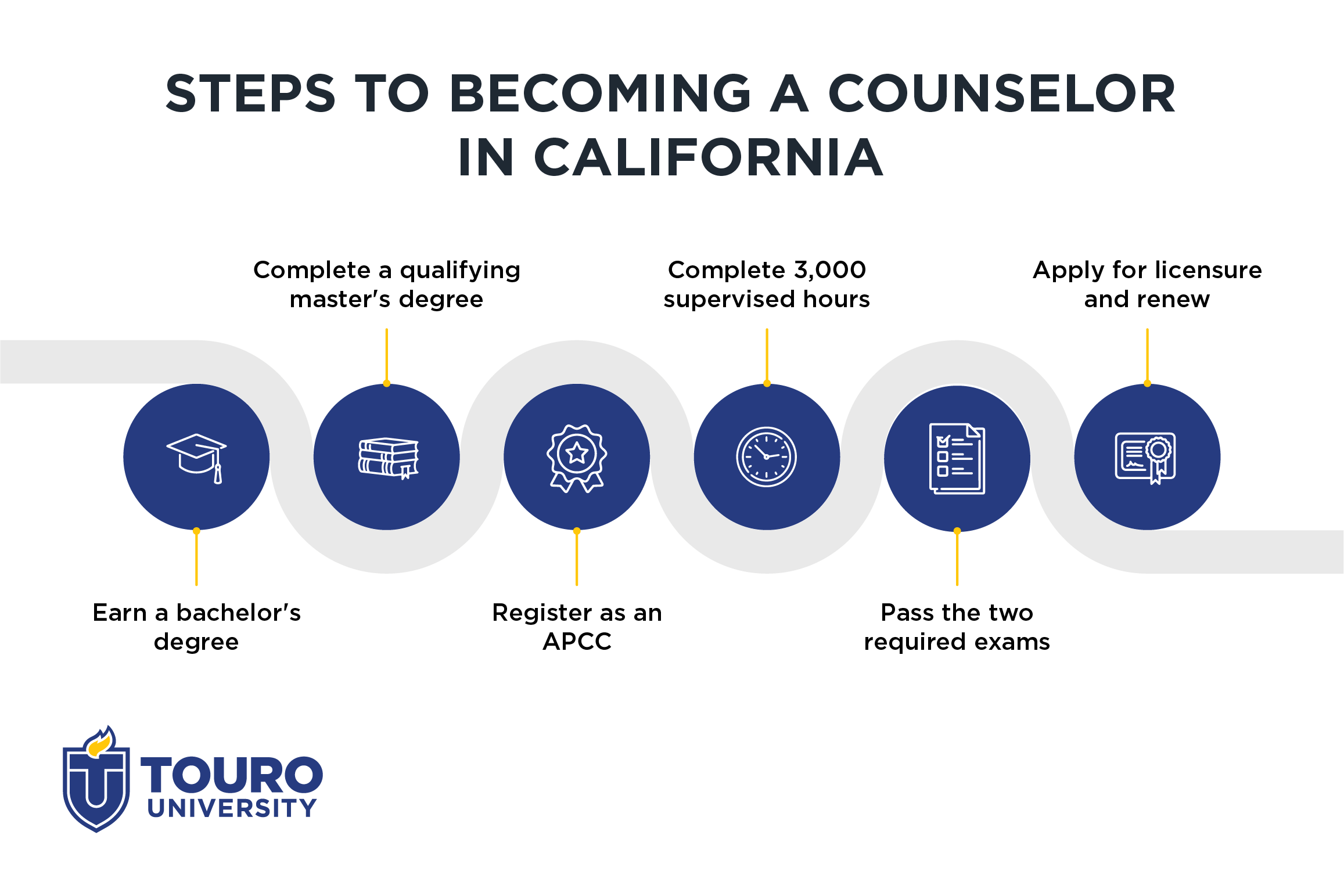
Step 1: Earn a bachelor’s degree
California doesn’t require a specific undergraduate major for LPCC applicants, so any bachelor’s degree qualifies. That said, a background in psychology, human services, sociology, or social work gives you a useful foundation for the graduate coursework ahead.
Students entering the field without this background may consider TUW’s bachelor’s degree in psychology with a human services concentration, which is designed to support careers in mental health and human services.
Step 2: Complete a qualifying master’s degree
California’s education requirements for LPCC licensure are detailed. For most current applicants, a qualifying program must include:
- A master’s or doctoral degree of at least 60 semester units in counseling or a related field.
- Graduate coursework equivalent to at least three semester units in each of the 13 required core content areas. The degree must contain at least 10 of these areas, including assessment and diagnosis, while up to three others may be completed separately through qualifying graduate coursework.
- At least six semester units of supervised practicum or field study, including 280 hours of supervised face-to-face clinical counseling experience with individuals, families, or groups.
- At least 15 semester units of advanced coursework beyond the required core content areas.
- Additional coursework and training required by the California Board of Behavioral Sciences (BBS), including California law and professional ethics.
- A degree from an institution with regional or national institutional accreditation recognized by the U.S. Department of Education, or from a school approved by the California Bureau for Private Postsecondary Education.
Touro University Worldwide’s Counseling Licensure Track pairs the MFT curriculum with four additional courses California requires for LPCC eligibility. The combined 82-credit program is approved by the California BBS, delivered fully online, and priced with affordable tuition at a nonprofit university. If cost is a factor in your planning, TUW’s financial aid options are worth reviewing early.
For working adults, the combination of online access and manageable tuition may make graduate study easier to fit around existing responsibilities. Hyemi Kim, a graduate of TUW’s Master of Arts in Marriage and Family Therapy program, shared her experience:
“The affordability of TUW and the easy access through navigating the online platform were the best options for me. … As a single mother, someone who’s working full-time as well, because of TUW, I was able to go to school, provide for my son, work, and pay for tuition all at the same time.”
Step 3: Register as an APCC

After graduating, apply to the BBS for registration as an Associate Professional Clinical Counselor (APCC). Older resources may use “PCCI,” short for Professional Clinical Counselor Intern, but California replaced that title with APCC in 2018.
A timing rule known as the 90-day rule may affect when your supervised hours begin to count. If the BBS receives your complete APCC application within 90 days of the date your degree was awarded, you may be able to count supervised hours while your application is still under review.
You cannot provide clinical services in a private practice or professional corporation until the BBS issues your APCC registration number. If the BBS receives your application more than 90 days after your degree was awarded, you must wait until your registration number is issued before beginning to count postdegree hours.
Step 4: Complete 3,000 supervised hours
California sets specific requirements for the 3,000 hours of supervised experience:
- 3,000 postdegree hours completed over at least 104 supervised weeks.
- At least 1,750 hours of direct clinical counseling with individuals, groups, couples, or families.
- Up to 1,250 hours of nonclinical work, such as supervision, clinical documentation, psychological testing, client advocacy, and professional training.
- Supervision during every week counted toward licensure. One unit means one hour of individual or triadic supervision or two hours of group supervision. At least 52 weeks must include individual or triadic supervision.
Your supervisor must meet the BBS supervisor qualifications. Eligible professionals include LPCCs, LMFTs (Licensed Marriage and Family Therapists), LCSWs (Licensed Clinical Social Workers), licensed psychologists, licensed educational psychologists, and board-certified psychiatrists. Additional licensing, experience, practice, and training requirements apply.
An APCC registration lasts one year and may be renewed five times, giving it a six-year lifespan. You may apply for a subsequent registration if you need more time, but only experience earned within the six years before the BBS receives your licensure application will count.

Step 5: Pass the two required exams
Two exams stand between you and full licensure, taken in order. First is the California Law and Ethics Exam, which you can take during your APCC period, typically in your first year. Second is the National Clinical Mental Health Counseling Examination (NCMHCE), taken only after your supervised hours are complete and the BBS has cleared you to sit for it.
The NCMHCE is administered through the National Board for Certified Counselors. It presents clinical case studies followed by multiple-choice questions that test how you apply counseling knowledge to assessment, diagnosis, treatment planning, and client care.
Step 6: Apply for licensure and renew
After completing your supervised hours and passing the California Law and Ethics Exam, submit the Application for Licensure with your experience verification forms and the required fee. The BBS reviews your application and supervised hours before approving you to take the NCMHCE.
Once you pass the NCMHCE, you must submit a Request for Initial License Issuance and pay the initial license fee within one year. After your license is issued, you will renew it every two years and complete 36 hours of continuing education during each renewal period.
What counseling credentials exist in California?
Not every counselor role in California uses the same credential, so it helps to know which one fits your goals before you enroll. The table below compares four common options. This guide focuses on the LPCC.
| Credential | Governing body | Education and training | Primary focus |
|---|---|---|---|
| Licensed Professional Clinical Counselor LPCC | Board of Behavioral Sciences (BBS) | Qualifying master’s or doctoral degree, supervised experience, and licensing exams | Clinical counseling and psychotherapy |
| Licensed Marriage and Family Therapist LMFT | Board of Behavioral Sciences (BBS) | Qualifying master’s or doctoral degree, supervised experience, and licensing exams | Psychotherapy with an emphasis on relationships and family systems |
| School counselor PPS credential | California Commission on Teacher Credentialing | Bachelor’s degree and a Commission-approved postgraduate preparation program with a practicum | Academic, career, and social-emotional support in schools |
| Substance use disorder counselor | A certifying organization approved by DHCS | Registration followed by the education, experience, and examination requirements of the chosen organization | Alcohol and other drug treatment and recovery services |
Licensed professional clinical counselor (LPCC)
The LPCC is California’s primary clinical counseling license, regulated by the BBS. LPCCs provide counseling and psychotherapy and may diagnose and treat mental health and substance use disorders. They work in private practice, community behavioral health clinics, hospitals, and other mental health settings.
Licensed marriage and family therapist (LMFT)
The LMFT is another clinical license regulated by the BBS. LMFTs provide psychotherapy to individuals, couples, families, and groups, with training that emphasizes relationship dynamics and family systems. TUW’s online Master of Arts in Marriage and Family Therapy leads to the LMFT license, and paired with the Counseling Licensure Track, it can also meet LPCC coursework requirements.
School counselor (PPS credential)
School counseling follows a separate credentialing process. California school counselors earn a Pupil Personnel Services credential with a specialization in school counseling through the Commission on Teacher Credentialing, not the BBS.
For applicants prepared in California, the credential requires a bachelor’s degree or higher and at least 48 semester units of postgraduate study in a Commission-approved school counseling program, including a practicum with school-aged children. The governing agency and preparation requirements differ from LPCC licensure, and the work is centered in school settings.
Substance use disorder counselor
California does not issue a single BBS license for substance use disorder counselors. People who provide counseling in alcohol and other drug programs licensed or certified by the Department of Health Care Services must register with a DHCS-approved certifying organization and earn certification within five years.
A master’s degree is not generally required, but education, supervised experience, and examination requirements vary by certifying organization and certification level. This route may allow you to begin working sooner than the LPCC or LMFT routes, but it does not provide the same scope of practice as either clinical license.
How long does it take to become a counselor in California?

Starting without a bachelor’s degree, becoming an LPCC in California typically takes about eight to ten years. This includes roughly four years for a bachelor’s degree, two to three years for a qualifying master’s degree, and at least two years to complete the required 3,000 supervised hours over 104 weeks.
For someone who already has a bachelor’s degree, the process may take about four to six years. The 90-day rule may allow eligible graduates to begin counting hours while their APCC application is under review, helping them avoid an unnecessary gap after graduation.
How much do counselors earn in California?
The latest available BLS data places California among the leading states for counselor employment. It has the highest employment level and job concentration for counselors classified as “all other”. California also employs more substance abuse, behavioral disorder, and mental health counselors than any other state, with 54,660 jobs and an average annual wage of around $67,000.
The median annual wage for substance abuse, behavioral disorder, and mental health counselors is approximately $60,000 nationwide. The lowest-paid 10 percent earn less than $39,090, while the highest-paid 10 percent earn more than $98,210. Employment in the field is projected to grow 17 percent over the current BLS projection period, much faster than the average for all occupations.
Marriage and family therapists earn a higher national median salary of around $64,000. Earnings vary by location, employer, experience, caseload, and employment arrangement. Check different career options for MFT graduates to learn more about roles and work settings available with this degree.
The bottom line
Becoming a counselor in California requires four major steps: completing a qualifying master’s degree, registering as an APCC, earning 3,000 supervised hours, and passing two exams. Planning the sequence early is important because rules such as the 90-day provision and the six-year APCC registration window can affect when your hours count and how long the process takes.
Touro University Worldwide’s online Counseling Licensure Track is offered by a nonprofit, WSCUC-accredited university and is designed around California’s education requirements for LPCC eligibility. The program has no on-campus residency requirement, offers several start dates throughout the year, and uses eight-week courses taught by faculty with clinical experience. Through admissions, you can request more information or begin your application.
Frequently asked questions (FAQs)
Do you need a license to be a counselor in California?
It depends on the role. You need an LPCC or another qualifying professional license, such as an LMFT or LCSW, to practice clinical counseling or psychotherapy independently. Other roles follow different rules. For example, counselors working in certain substance use disorder programs register with and become certified through a DHCS-approved certifying organization rather than obtaining a BBS license.
Can you become a counselor in California with an online degree?
Yes. The BBS recognizes online programs designed to meet California’s LPCC requirements, but the delivery format alone does not make a degree eligible. The institution, coursework, credit total, and practicum must meet California’s requirements. Your practicum must include supervised direct client contact, and your post-degree experience must also be completed under qualified supervision.
What is the difference between an LPCC and an LMFT in California?
Both are BBS clinical licenses with similar structures, but an LPCC focuses on individual and group counseling, while an LMFT focuses on couples, families, and relationship systems.
Can you become a counselor without a master’s degree in California?
Not if your goal is LPCC or LMFT licensure. Both require a qualifying graduate degree. Some nonclinical and substance use disorder counseling roles do not require a master’s degree. In certain DHCS-licensed or certified programs, an unlicensed counselor may begin as a registrant and must complete certification through an approved organization within five years. The exact education and training requirements depend on the certification level and organization.
Is becoming a counselor in California worth it?
That depends on your career goals, available time, and the cost of completing the licensure process. Demand provides one useful measure: the BLS projects employment of substance abuse, behavioral disorder, and mental health counselors to grow 17 percent during its current projection period, compared with 3 percent across all occupations.