


How to Become an LMFT in California: 2026 Guide
Key takeaways
- In California, an LMFT is licensed by the BBS, which sets the state’s education, supervised experience, examination, and application requirements.
- Becoming an LMFT in California includes earning a qualifying 60-unit master’s, registering as an AMFT, completing 3,000 supervised hours, and passing two state exams.
- California currently requires its own Law and Ethics Exam and LMFT Clinical Exam. Most other states use the national AMFTRB exam. The BBS is working toward replacing California’s Clinical Exam with the AMFTRB exam, with the transition projected for July 1, 2027, pending completion of the regulatory process.
- An initial AMFT registration can be renewed annually for up to six years.
- The full process of becoming an LMFT often takes around seven to ten years from the start of a bachelor’s degree. The exact timeline depends on the graduate program and how steadily supervised hours are completed.
- Touro University Worldwide’s online Master of Arts in Marriage and Family Therapy is COAMFTE-accredited with show cause and BBS-approved, and it’s built to meet California’s education requirements.
Becoming a Licensed Marriage and Family Therapist (LMFT) in California means completing a specific sequence defined by the Board of Behavioral Sciences (BBS): earning a qualifying degree, registering as an associate, completing supervised hours, and passing two exams. This guide explains each stage in order. Readers still exploring the profession can begin with a broader look at the MFT career before focusing on California’s specific requirements.
This resource is for adult learners and career changers who already know they want to practice in California and need the exact requirements, including hours, exams, timeline, and cost. Touro University Worldwide is a California-based, nonprofit, WSCUC-accredited university whose MFT program is built around BBS requirements, so we regularly hear these questions from prospective students.
How to become an LMFT in California: Step by step
The California licensing process involves more than completing academic and clinical requirements. Applicants must submit the correct forms, document their experience carefully, and meet BBS deadlines throughout the licensing process. The steps below explain what each phase requires and how to avoid common delays.
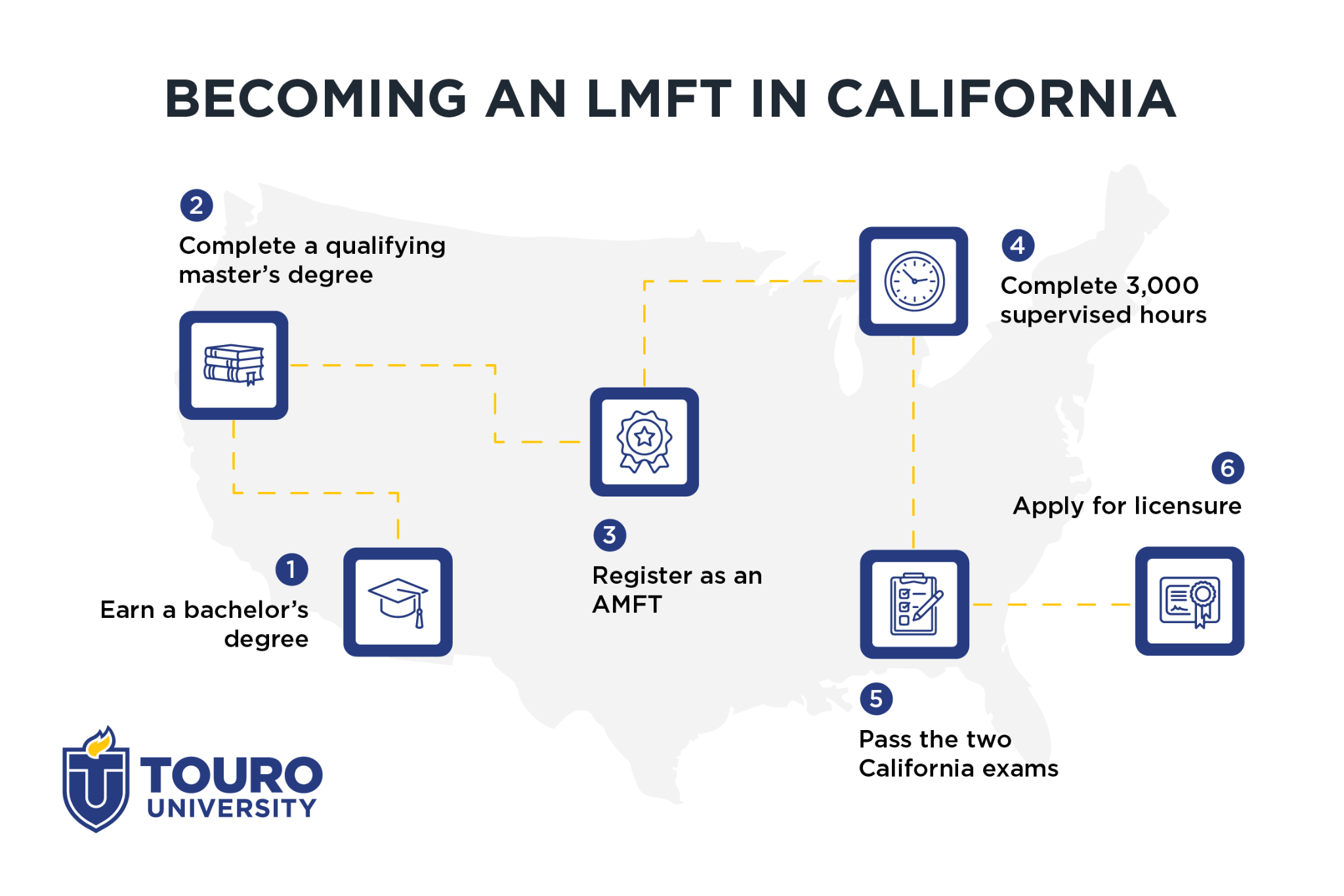
Step 1: Earn a bachelor’s degree
California does not require a specific undergraduate major for LMFT licensure. You may study any subject, though psychology, human services, or social work can help prepare you for graduate-level coursework. You can begin counting a limited number of trainee hours only after enrolling in a qualifying graduate program, not while completing your bachelor’s degree.
Step 2: Complete a qualifying master’s degree
California’s education requirements become more specific at the graduate level. A qualifying program must include:
- A master’s or doctoral degree with at least 60 semester units or 90 quarter units in marriage and family therapy or another eligible field, with coursework that meets Business and Professions Code Section 4980.36.
- Required subjects such as human sexuality, spousal or partner abuse, aging and long-term care, substance use disorders, psychopharmacology, child abuse reporting, and California law and ethics.
- At least six semester units or nine quarter units of supervised practicum, including 150 hours of direct counseling experience and 75 additional hours of counseling or client-centered advocacy.
Applicants must also complete six hours of suicide risk assessment training and three hours of telehealth training. These requirements may be included in the degree or completed later through another BBS-approved option.
Some practicum experience can count toward the 3,000 hours required for licensure. Up to 500 hours of counseling and supervision completed as a trainee may still count even when they fall outside the BBS’s usual six-year limit.
The degree must satisfy the BBS requirements, and the board makes the final decision about eligibility. Choosing a program designed around California’s rules can reduce the risk of missing coursework or needing additional classes later.
Touro University Worldwide’s online Master of Arts in Marriage and Family Therapy is COAMFTE-accredited, with show cause and approved by the California BBS. It’s delivered online at a nonprofit university, with affordable, locked-in tuition for students who remain actively enrolled, and it’s designed so graduates meet California’s education requirements without needing extra coursework.
TUW MFT graduate Jennifer France Talvitie returned to school at 50 while balancing work and family responsibilities. Speaking about her time at TUW, she said:
“I needed something that I could take with me wherever I was. . . . Online was perfect for that. . . . It fit right into my lifestyle, right into the busyness of motherhood [and] working.”
Watch Jennifer discuss her TUW MFT experience.
Step 3: Register as an AMFT

After graduation, apply to the BBS for AMFT (Associate Marriage and Family Therapist) registration so you can continue earning supervised experience toward licensure. The application requires official transcripts, fingerprinting for DOJ and FBI background checks, and a registration fee (currently $75 as of the BBS’s July 2026 fee reduction, down from the prior $150).
Make sure the BBS receives your application within 90 days of the date your degree was awarded if you want eligible hours earned before registration issuance to count. You must also complete an employer-required Live Scan before earning those hours and keep a copy of the form for your licensure application. This is separate from the Live Scan required for AMFT registration. Missing either condition means the hours earned before your registration was issued will not count.
An AMFT registration allows you to gain experience under supervision. It is not the independent LMFT license, which comes after you complete the remaining requirements.
Step 4: Complete 3,000 supervised hours
California requires both 3,000 hours of supervised experience and at least 104 supervised weeks. Those hours must include:
- At least 1,750 hours of direct clinical counseling.
- Within that, at least 500 hours diagnosing and treating couples, families, or children.
- No more than 1,250 hours of nonclinical work.
- One unit of supervision each week in which you perform direct clinical hours.
An AMFT registration expires each year and may be renewed five times, giving the original registration a total lifespan of six years. If you need more time, you can apply for a subsequent registration before the first one expires.
Step 5: Pass the two California exams
California requires two exams, taken in order. The first is the California Law and Ethics Exam, which you can take while registered as an AMFT. It includes 75 questions, 50 of which are scored, and allows 90 minutes. The content is divided between ethics at 56% and law at 44%. If you do not pass, you must wait 90 days before trying again and continue taking the exam at least once each year to renew your registration.
After completing your supervised experience, passing the Law and Ethics Exam, and receiving approval of your licensure application, you may take the California LMFT Clinical Exam. California currently uses its own state-developed clinical exam rather than the national AMFTRB exam used elsewhere.
The BBS is working toward adopting the AMFTRB national exam, but the proposed transition date has been extended to July 1, 2027, and the required regulations are not yet final. Applicants testing in 2026 will therefore take the current California exam. Exam fees may change, so confirm the amount with the BBS before applying.
Step 6: Apply for licensure and renew

After completing your supervised hours and passing the Law and Ethics Exam, submit the Application for Licensure with your experience records. Once the BBS approves your application, you may take the Clinical Exam. After passing, submit the Request for Initial License Issuance and pay the issuance fee.
California LMFT licenses must be renewed every two years. Each renewal period requires 36 hours of continuing education, including six hours of law and ethics.
How long does it take to become an LMFT in California?
The full process often takes around seven to ten years from the start of a bachelor’s degree. This generally includes four years for the bachelor’s degree, two to three years for a qualifying master’s program, and additional time to complete the required 3,000 supervised hours and exams. Some supervised hours earned during graduate school may count, so the exact timeline depends on your program and how steadily you gain experience. California requires the hours to span at least 104 supervised weeks.
TUW’s full-time MFT Track is designed for completion in about 2.5 years, allowing students to begin the post-degree licensing requirements sooner. The initial AMFT registration still has its own six-year limit after it is issued.
How much do LMFTs earn in California?
According to the U.S. Bureau of Labor Statistics, the median wage for marriage and family therapists nationwide is around $64,000 annually. California employs an estimated 32,000 MFTs, more than any other state, reflecting the size of its licensed workforce and the state’s emphasis on expanding access to mental health services.
Employment in the field is projected to grow 13 percent from 2024 to 2034, much faster than the average for all occupations.
Earnings vary by location, work setting, experience, and license status. AMFTs completing their supervised hours generally earn less than fully licensed LMFTs, while private-practice income depends on factors such as caseload, rates, and operating costs. BLS wage estimates exclude self-employed therapists, so they do not reflect the earnings of many LMFTs in private practice.
To see where the degree can lead, explore common MFT career options and work settings. Salary figures provide a general benchmark rather than a guarantee of individual earnings.
LMFT vs. LPCC in California: Which path fits you?

Both LMFTs and LPCCs are clinical licenses regulated by the California BBS. Each requires a qualifying graduate degree, associate registration, 3,000 supervised hours, and the required licensing exams. The main difference is the focus of the training. The LMFT is built around relationships, couples, and family systems, while the LPCC concentrates on individual clinical mental health counseling.
Students interested in individual counseling may find that the LPCC aligns more closely with their goals. Some pursue both credentials because many of the educational requirements overlap, although each license still has its own associate registration, supervised experience, and exam requirements.
TUW’s Counseling Licensure Track builds on the MFT curriculum with four additional LPCC courses. The 82-credit track is approved by the California BBS and is designed to meet the educational requirements for both LMFT and LPCC licensure without requiring a separate degree.
The bottom line
Becoming an LMFT in California requires four main steps: completing a qualifying master’s degree, registering as an AMFT, earning 3,000 supervised hours, and passing two California-specific exams. Deadlines, documentation, and rules for counting hours can affect how long the process takes, so understanding the full sequence before choosing a program can help prevent delays.
Touro University Worldwide’s online MFT degree is offered by a nonprofit, WSCUC-accredited university and is designed around California’s education requirements. The program has no on-campus residency requirement, offers multiple start dates throughout the year, and uses eight-week courses taught by faculty with clinical experience. Through admissions, you can request information or begin your application.
Frequently asked questions (FAQs)
How much does it cost to become an LMFT in California?
Costs include graduate tuition, fingerprinting, AMFT registration, exams, and licensure fees. Under the BBS fee reductions effective July 1, 2026, these fees total $500 before fingerprinting, retakes, or renewals. Graduate tuition is by far the largest expense, though eligible TUW students may qualify for financial aid.
Can you become an LMFT in California with an online degree?
Yes. An online graduate program may qualify if the institution and curriculum meet California’s education requirements. Online coursework does not remove the required practicum and supervised clinical experience, which must involve work with clients and follow BBS, program, and placement-site rules.
What is the difference between an AMFT and an LMFT?
The AMFT is a pre-license registration that lets you accrue supervised hours under a licensed supervisor. The LMFT is the full license that allows independent practice.
Does California use the national MFT exam?
Not currently. California requires its own Law and Ethics Exam and state-developed Clinical Exam. The BBS is working toward replacing the Clinical Exam with the national AMFTRB exam on July 1, 2027, but that change still requires final regulatory approval.
Can an out-of-state LMFT get licensed in California?
Path A is available to eligible applicants who have held an active, unrestricted independent MFT license in another U.S. jurisdiction for at least two years. Applicants who do not meet those conditions generally apply through Path B, under which the BBS reviews their education and experience and may require additional coursework or supervised hours.
Is an LMFT the same as an MFT?
Not quite. “MFT” may refer to marriage and family therapy as a profession, an academic program, or a therapist more generally. “LMFT” refers specifically to someone who has completed the state’s requirements and holds a marriage and family therapist license.