


How to Become a School Social Worker: Steps and Requirements
Key takeaways
- School social worker requirements vary by state, but many roles require a Master of Social Work (MSW) along with state-specific education, social work, or school-service credentials.
- A Bachelor of Social Work (BSW) provides the most direct undergraduate preparation and may qualify graduates for advanced standing in an MSW program, which can shorten graduate study.
- BLS projects employment of social workers overall to grow 6% from 2025 to 2035.
- Touro University Worldwide’s CSWE-accredited Bachelor of Arts in Social Work offers a 12-credit School Social Work concentration, with online coursework, eight-week sessions, and required field education.
Becoming a school social worker means meeting both social work education requirements and the credentialing rules for the state where you plan to work. Depending on the state, you may need an MSW, a school-specific credential, social work licensure, or a combination of these requirements.
The sections below explain the education and field experience that can prepare you for school social work, how state credentials differ, typical timelines, salary, and the distinction between school social workers and school counselors.
How to become a school social worker: Step by step
The route to school social work depends on the state where you plan to practice. Many roles require graduate social work education along with school-focused field experience and a state-specific credential or endorsement.
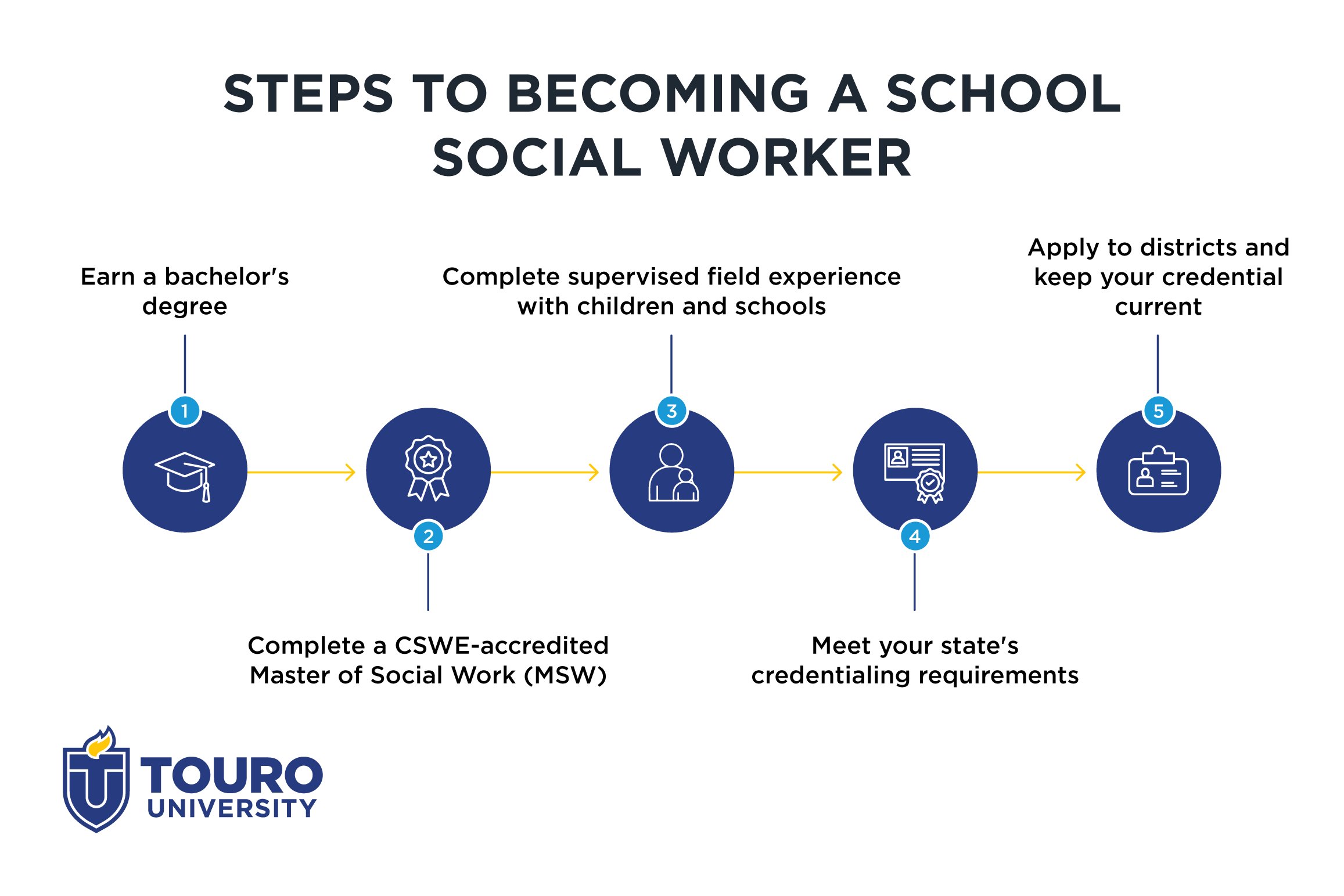
Step 1: Earn a bachelor’s degree
A Bachelor of Social Work (BSW) is the most direct undergraduate route because it combines social work education with supervised field experience. Students with bachelor’s degrees in related fields such as psychology, sociology, or human services can also apply to many traditional MSW programs.
Touro University Worldwide’s 120-credit, CSWE-accredited Bachelor of Arts in Social Work includes a 12-credit School Social Work concentration covering youth at risk, child abuse, child welfare services, and school social work. Field placements for concentration students typically take place in K–12 schools, school districts, youth-serving organizations, or approved community agencies.
Students also learn from faculty who include professors holding State School Social Worker Certification, bringing professional school social work experience into the classroom.
The concentration does not itself lead to professional licensure or school social work certification. It provides undergraduate preparation that students can build on through graduate study and any credentials required by their state.
Step 2: Complete a CSWE-accredited Master of Social Work (MSW)
An MSW is the recommended entry-level qualification for school social workers under NASW standards and is required for many school social work credentials. Requirements still vary by state, so review the rules where you plan to work before selecting a graduate program.
One benefit of completing TUW’s CSWE-accredited social work program is the potential for a shorter route through graduate school. Eligible BSW graduates may qualify for advanced standing in an MSW program, allowing them to complete the degree in about one year rather than the roughly two years commonly required for a traditional MSW. Admission requirements and completion times depend on the MSW program.
When possible, choose an MSW program that offers school social work coursework or K–12 field placements, particularly if your state requires school-specific preparation.
Step 3: Complete supervised field experience with children and schools

Field education is a core part of social work preparation. When possible, choose placements in K–12 schools, school districts, or youth-serving organizations so you can build experience working with students, families, and education systems.
The amount and type of school-based experience required for credentialing varies by state. Some jurisdictions require specific internship or practicum experiences, while others use provisional credentials or additional supervised practice after graduation.
Keep records of your placements, hours, and supervision, since state credentialing applications may require documentation of your field experience.
Step 4: Meet your state’s credentialing requirements
School social work credentialing varies by state. Depending on where you plan to work, requirements may be set by a state education department, credentialing commission, social work board, or another state entity.
You may need a school-specific certificate or endorsement, a social work license, or a combination of credentials. Requirements can include an MSW, school social work coursework, supervised field experience, or completion of an approved preparation program.
Because these rules differ by jurisdiction, review your state’s current requirements before choosing a graduate program or applying for school social work positions.
Step 5: Apply to districts and keep your credential current
Once you meet your state’s requirements, you can apply for school social work positions through school districts, local education agencies, and other qualifying school settings. Hiring requirements may still vary by employer, even within the same state.
After you are hired, keep your required credentials current by meeting applicable renewal or continuing education requirements. With experience, school social workers may move into lead or coordinator roles, pursue clinical licensure where relevant to their goals, or advance into other student-support and social work positions.
School social worker requirements by state
School social work requirements vary considerably. Depending on the state, credentials may be issued by an education department, credentialing commission, or another state entity, and social work licensure may be a separate requirement.
| Example state | Who issues the school credential | Current requirement |
|---|---|---|
| New York | New York State Education Department | MSW for the provisional certificate; LMSW or LCSW required for the permanent certificate |
| New Jersey | New Jersey Department of Education | Master’s degree or higher plus 30 graduate credits in specified areas |
| California | California Commission on Teacher Credentialing | At least 45 post-baccalaureate semester units in an approved program, including a school-based practicum |
| Illinois | Illinois State Board of Education | Master’s in social work with school social work specialization plus an approved preparation route |
| Most other states | State education department or other state credentialing body | Requirements vary, but an MSW and a school-specific credential, endorsement, or social work license are common |
Because requirements can change, verify the current rules for the state where you plan to work before choosing a degree or preparation program.
How long does it take to become a school social worker?
For someone starting with no college education, becoming a school social worker often takes about 5 to 7 years, depending on the state and the graduate program you choose.
A typical timeline looks like this:
- Bachelor’s degree: about 4 years of full-time study
- MSW: about 2 years for a traditional program, or roughly 1 year through advanced standing for eligible BSW graduates
- State credentialing: often several additional months, although some states require extra field experience, exams, or provisional credentials that can extend the process
If you already hold a bachelor’s degree, the remaining path is often about 2 to 3 years. Eligible BSW graduates may be able to complete the MSW and credentialing process in closer to 1 to 2 years, depending on the program and state requirements.
Our 8-week online sessions and six start dates a year give working adults several opportunities to begin or continue their studies throughout the year.
How much do school social workers earn?

According to the U.S. Bureau of Labor Statistics, child, family, and school social workers earn a median annual wage of around $60,000. This category includes school social workers along with professionals working in child welfare and family services, so it serves as a broader occupational benchmark.
For school-based social workers specifically, average annual pay in the U.S. is currently estimated at about $66,100, with most reported salaries falling between approximately $52,500 and $72,000.
Pay can vary by state, school district, experience, credentials, and contract structure. BLS projects employment of social workers overall to grow 6% from 2025 to 2035, faster than the average for all occupations.
The bottom line
Becoming a school social worker typically involves completing a bachelor’s degree, earning an MSW for many credentialed roles, gaining school-focused field experience, and meeting the requirements set by the state where you plan to work. For someone starting with no college education, the full process often takes about 5 to 7 years, although the timeline varies by program and state.
If you’re ready to begin preparing for this career, explore our CSWE-accredited Bachelor of Arts in Social Work with its School Social Work concentration at Touro University Worldwide, a nonprofit university accredited by WSCUC. You can also review tuition, explore financial aid options, or connect with admissions to request information or begin an application.
Frequently asked questions (FAQs)
What is the difference between a school social worker and a school counselor?
School social workers often focus on barriers affecting a student’s well-being and school success, including family circumstances, mental health needs, and access to community services. School counselors typically focus more on academic development, social skills, and planning for education or careers after graduation. The roles can overlap depending on the school or district.
Can you become a school social worker with an online degree?
Yes. An accredited online BSW or MSW can fully support this career path, as long as the program is CSWE-accredited and you complete the field hours and the required state credential.
What is the C-SSWS credential?
The Certified School Social Work Specialist (C-SSWS) is a voluntary national credential offered by NASW for experienced school social workers. Eligibility includes a CSWE-accredited MSW, at least 2,160 hours of paid supervised post-MSW school social work experience, and qualifying state licensure or school social work certification. It does not replace state credentialing requirements.
How hard is it to get a school social worker job?
That depends on the state, school district, and credentials required for the position. Completing school-based field experience and meeting your state’s credentialing requirements can strengthen your preparation, but hiring conditions vary by location and employer.
Is becoming a school social worker worth it?
It depends on your goals: the role offers meaningful work supporting students and families and a clearer entry path than some clinical specialties, though pay follows district salary schedules and the credentialing process takes real time to complete.