
How to Become a Human Resources Manager: Steps and Skills
Key takeaways
- Human resources managers typically need a bachelor’s degree and several years of related HR experience before moving into management.
- Experience in areas such as recruiting, employee relations, compensation, benefits, or training can help prepare HR professionals for broader management responsibilities.
- Professional certifications such as SHRM-CP, SHRM-SCP, PHR, and SPHR are voluntary credentials that can demonstrate HR knowledge.
- Human resources managers earn a median annual wage of around $150,000, and BLS projects employment to grow 6% from 2025 to 2035.
- TUW’s online MS in Human Resource Management is fully aligned with SHRM’s HR Curriculum Guidebook and Templates and can be completed in as little as one year of full-time study.
Human resources managers oversee areas such as hiring, training, employee relations, compensation, benefits, and workforce policies. The role typically requires several years of related HR experience, with many professionals first building their knowledge in specialist or generalist positions before taking on management responsibilities.
For professionals planning this career path, it’s important to understand the education and experience employers typically look for, the skills and certifications that can support advancement, how long the path may take, and when graduate study may be useful.
How to become a human resources manager: Step by step
Becoming an HR manager usually takes a combination of education and several years of related HR experience. According to the U.S. Bureau of Labor Statistics, HR managers typically need a bachelor’s degree and five years or more of related work experience, although requirements vary by employer.
The steps below show how professionals can build the knowledge and experience needed for HR management and where optional credentials such as certification or a master’s degree may fit.
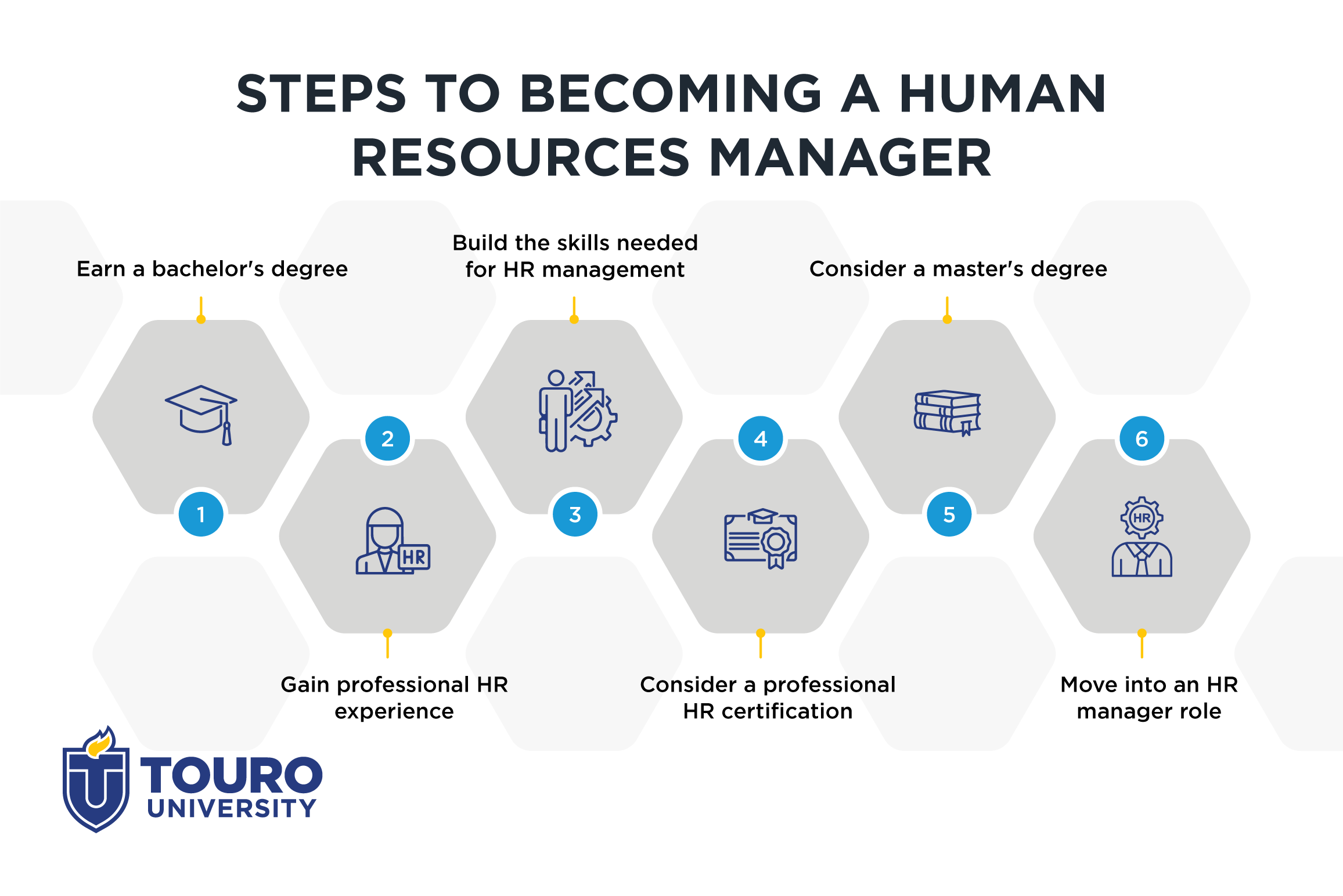
1. Earn a bachelor’s degree
HR managers typically need at least a bachelor’s degree. Relevant majors include human resources management, business administration, communications, psychology, and other fields that provide a foundation in organizations and workplace behavior.
Coursework in areas such as employment law, labor relations, economics, management, organizational behavior, compensation, and benefits can prepare you for entry-level HR responsibilities. A bachelor’s degree also gives you the educational foundation needed to begin building the professional experience that employers usually expect for management positions.
If you want to study HR at the undergraduate level, TUW’s online BSBA in Human Resources Management provides a business-focused foundation in human resources and management.
2. Gain professional HR experience

HR management is generally not an entry-level role. BLS reports that human resources managers typically have five years or more of related work experience, and some begin their careers as human resources specialists or labor relations specialists.
Early-career positions such as HR coordinator, recruiter, HR specialist, generalist, or benefits administrator can expose you to different parts of the employee lifecycle. Over time, this experience can help you learn how hiring practices, employee relations, benefits administration, and workplace policies operate in practice.
Look for opportunities to take on greater responsibility as you progress. Managing a project, supporting a policy change, or handling more complex employee issues can help demonstrate that you are ready for work with a broader organizational scope.
3. Build the skills needed for HR management
Moving into management requires more than technical knowledge of HR processes. HR managers need to communicate effectively with employees and organizational leaders, make informed decisions, handle sensitive workplace issues, and keep HR activities aligned with business needs.
BLS highlights communication, decision-making, interpersonal, leadership, and organizational skills as important for HR managers. Knowledge of employment law and HR policies is also important because managers may be responsible for helping an organization follow workplace regulations and apply policies consistently.
As your career develops, you may also work more closely with workforce data, HR technology, compensation planning, or organizational initiatives. Building experience in these areas can prepare you for the broader responsibilities that come with management.
4. Consider a professional HR certification
Professional certification is voluntary, but it can provide another way to demonstrate your HR knowledge and experience. Common options include the Society for Human Resource Management’s SHRM-CP and SHRM-SCP, as well as HRCI credentials such as the PHR and SPHR.
The right certification depends on where you are in your career. Some credentials are designed for professionals working at the operational level, while others require several years of experience and focus more heavily on strategic HR responsibilities.
Certification requirements differ, so review the eligibility rules for each credential before deciding which one fits your experience. Earning a certification does not replace the work experience employers typically expect for an HR manager role.
5. Consider a master’s degree
A master’s degree is not required for every HR manager position. BLS notes that some positions require a master’s degree in human resources, labor relations, or business administration.
Graduate study may be useful if you want more advanced preparation in areas such as employee relations, workforce strategy, training and development, or compensation. An MS in Human Resource Management focuses specifically on HR, while an MBA in Human Resources Management combines HR study with broader business and management coursework.
A master’s degree can supplement your professional experience, but it does not replace it. Employers hiring HR managers generally still look for evidence that you have handled HR responsibilities in a professional setting and are prepared to take on management-level work.
6. Move into an HR manager role

Once you have built substantial HR experience and developed the skills required for management, you can begin pursuing HR manager positions. Certification or graduate education may strengthen your preparation for some roles, but employers will also consider the depth and relevance of your professional experience.
HR managers may oversee HR specialists, manage employee relations issues, help establish workplace policies, and work with senior leaders on workforce priorities. The exact responsibilities depend on the size of the organization and how its HR function is structured.
As you evaluate openings, compare the position requirements with the areas of HR you have already worked in. Experience that shows increasing responsibility and familiarity with several HR functions can help demonstrate your readiness to move from specialist or generalist work into management.
HR manager skills employers look for
HR managers need more than knowledge of HR processes. Their role often involves interpreting workplace rules, handling sensitive employee issues, using workforce information to support decisions, and helping leadership plan for staffing and organizational needs.
| Skill | Why it matters |
|---|---|
| Employment law knowledge | HR managers need a working understanding of federal and state employment laws, workplace policies, and compliance requirements. This helps them identify potential risks, apply policies consistently, and know when an issue may require legal or specialist input. |
| Conflict resolution | Employee grievances, performance concerns, and disagreements between employees or managers may escalate to HR. Strong conflict-resolution skills help HR managers gather information, keep discussions productive, and work toward appropriate next steps without losing sight of policy or fairness. |
| Data analysis | Workforce data can help HR managers identify patterns in areas such as hiring, turnover, compensation, and employee retention. The goal is not simply to report numbers, but to use them to support decisions and explain HR priorities to organizational leaders. |
| Communication | HR managers communicate with employees, managers, executives, and outside partners, often about complex or sensitive issues. They need to explain policies clearly, adapt their communication to different audiences, and make sure important information is understood. |
| Strategic planning | At the management level, HR work extends beyond day-to-day administration. HR managers may contribute to workforce planning, compensation decisions, employee development, and other initiatives that support broader organizational goals. |
HR certifications: Which ones matter for managers?
HR certifications are optional, but they can demonstrate your knowledge and, for senior-level credentials, your professional experience. The right certification depends largely on your career stage and the type of HR work you perform.
| Certification | Offered by | Best suited for |
|---|---|---|
| aPHR Associate Professional in Human Resources | HRCI | People beginning an HR career with little or no professional HR experience |
| PHR Professional in Human Resources | HRCI | HR professionals whose work focuses on technical and operational responsibilities |
| SPHR Senior Professional in Human Resources | HRCI | Experienced HR professionals responsible for strategy and policy |
| SHRM-CP SHRM Certified Professional | Society for Human Resource Management | Professionals performing operational HR duties or pursuing an HR career |
| SHRM-SCP SHRM Senior Certified Professional | Society for Human Resource Management | Experienced professionals performing strategic-level HR work |
These are voluntary professional certifications, not licenses required to work as an HR manager. Eligibility also differs by credential. For example, SHRM-CP does not require previous HR experience, while SHRM-SCP requires at least three years of strategic-level HR work or the qualifying SHRM-CP pathway. Employers weigh certifications differently, so review job postings in your target field to see which credentials appear most often.
How long does it take to become an HR manager?
The timeline varies depending on your education and prior HR experience. If you’re starting with no college degree or professional HR background, you may spend about four years earning a bachelor’s degree before building the related work experience employers expect for management roles.
The U.S. Bureau of Labor Statistics reports that human resources managers typically need five years or more of related work experience. That experience may come from roles such as HR specialist, recruiter, generalist, or labor relations specialist, with responsibilities increasing over time.
If you already have a bachelor’s degree and several years of HR experience, your path may be considerably shorter. Professional certification or a master’s degree can be completed along the way if they fit your career goals, but neither is required for every HR manager position.
How much do human resources managers earn?

According to the U.S. Bureau of Labor Statistics, human resources managers earn a median annual wage of $149,280. Employment is projected to grow 6% from 2025 to 2035, faster than the average for all occupations, with about 16,800 openings projected each year. Many of those openings are expected as workers transfer to other occupations or leave the workforce.
By comparison, human resources specialists, a common role for professionals building experience before moving into management, earn a median annual wage of $75,940. The comparison shows the higher earnings associated with the management-level occupation, although pay varies considerably within both roles.
Actual earnings depend on factors such as industry, location, employer, and the scope of the position, so these figures are best used as general benchmarks.
How TUW can support your path to HR management
If you want to build graduate-level HR knowledge as you prepare for broader responsibilities, TUW’s online MS in Human Resource Management offers a 36-credit curriculum covering areas such as organizational strategy, compliance, training and development, and HR management. The program is fully aligned with SHRM’s HR Curriculum Guidebook and Templates and is delivered in eight-week courses with six start dates each year.
You can choose from three 9-credit concentrations: Training and Development, Employee Engagement and Total Rewards, or Employee and Labor Relations. No GRE is required; the application fee is waived for MSHRM applicants, and up to nine transfer credits may be accepted. Full-time students can complete the degree in 12 months, while part-time students typically finish in about 1.5 years.
Tuition is currently $500 per credit, bringing tuition for the 36-credit program to $18,000 before approved transfer credits, scholarships, or financial aid. Students can review current tuition and financial aid options when planning for the cost of the degree.
The MSHRM does not lead to professional licensure or automatically award an HR certification. SHRM-CP and SHRM-SCP are separate professional credentials with their own eligibility requirements and exams. TUW’s SHRM-aligned curriculum is based on the same professional knowledge framework used by SHRM, but completing the degree does not itself confer certification.
The bottom line
Becoming an HR manager usually requires a bachelor’s degree and several years of related HR experience. There is no single required path, and professional certification or a master’s degree may provide additional preparation depending on your career goals and the positions you want to pursue.
If you’re ready to build graduate-level HR knowledge, explore TUW’s online MS in Human Resource Management and see how it fits into your career plan.
Frequently asked questions (FAQs)
Do you need a master’s degree to become an HR manager?
No. A master’s degree is not required for every HR manager position. BLS notes that some positions require a master’s degree in human resources, labor relations, or business administration, while the typical entry-level education for the occupation is a bachelor’s degree.
What certification is best for an HR manager?
There is no single best certification. SHRM-SCP and SPHR are designed for more experienced professionals working at a strategic level, while SHRM-CP and PHR are geared toward professionals whose responsibilities are more operational. The right choice depends on your experience and the credentials employers in your field value.
How much experience do you need to become an HR manager?
BLS reports that human resources managers typically need five years or more of related work experience. That experience may come from positions such as HR specialist, labor relations specialist, recruiter, or generalist, although individual employers set their own requirements.
Is an MS in Human Resource Management worth it?
It depends on your career goals and the positions you want to pursue. An MS in Human Resource Management can provide graduate-level study in areas such as HR strategy, employee relations, compensation, and workforce development. Because a master’s degree is not required for every HR manager role, consider the program’s cost and time commitment alongside the requirements of positions you are targeting.