

How to Become a Mediator: Training and Education
Key takeaways
- There is no single national license or certification for mediators. Requirements depend on the state, court system, and type of mediation you want to practice.
- BLS says arbitrators, mediators, and conciliators typically need at least a bachelor’s degree and related work experience, although specific mediator programs may set different education requirements.
- Court-connected mediation programs may require approved training, observation, co-mediation, or documented case experience before you can join a roster or mediate independently.
- Arbitrators, mediators, and conciliators earn a median annual wage of around $75,500, and BLS projects employment to grow 5% from 2025 to 2035.
- Touro University Worldwide’s 100% online Master of Arts in Dispute Resolution is a 36-credit program covering negotiation, mediation, arbitration, and related dispute resolution methods, with full-time completion possible in as little as one year.
The process of becoming a mediator depends heavily on where and how you want to practice. Private mediation may have few formal entry requirements, while court-connected programs can require specific training, experience, or roster qualifications.
For adult learners and career changers, including professionals in HR, education, legal services, human services, and other conflict-focused roles, it’s important to understand the education and training that can support a mediation career, how court and state requirements differ, and what to expect from the profession in terms of skills, timeline, and salary.
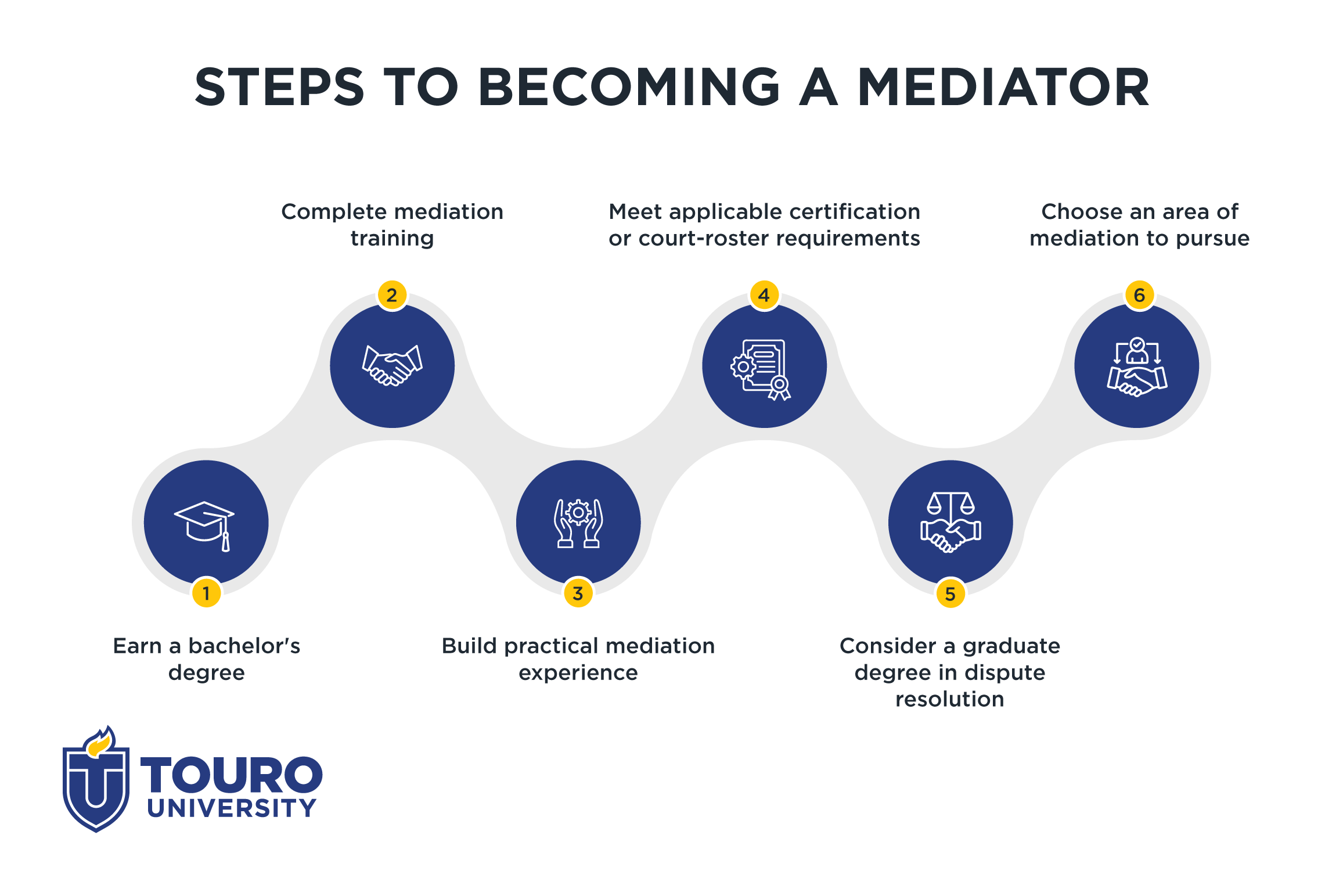
How to become a mediator: Step by step
There is no single national route to becoming a mediator. Education, training, and experience requirements depend on the type of mediation you want to practice and the rules of the court or program you want to work with. Court-connected mediation often has more formal requirements than private mediation.
Step 1: Earn a bachelor’s degree
According to the U.S. Bureau of Labor Statistics, arbitrators, mediators, and conciliators typically need at least a bachelor’s degree and related work experience. There is no required undergraduate major, and relevant education often depends on the area in which you plan to mediate.
Fields such as psychology, human services, business, human resources, and legal studies can all provide useful preparation. Experience in areas such as HR, case management, legal services, or community work may also help you build knowledge that later applies to mediation.
For students interested in human behavior and conflict resolution, Touro University Worldwide’s online BA in Psychology with a Human Services concentration provides one possible undergraduate foundation.
Step 2: Complete mediation training
Mediation training requirements vary considerably. Court-connected programs may require an approved basic training course, with the number of hours depending on the jurisdiction and type of cases you want to handle.
California shows how much those requirements can differ even within one state. Court-connected child custody mediators must complete at least 40 hours of training within their first six months of employment, while other court mediation programs use different standards.
Before enrolling, check the requirements of the court, state program, or mediator roster you hope to join. Some programs specify approved training providers or particular courses that must be completed for your training to count.
Step 3: Build practical mediation experience

Some court-connected programs require candidates to gain supervised mediation experience or meet professional experience requirements before handling cases independently. Community mediation programs and nonprofit dispute resolution organizations may also provide opportunities to practice mediation skills.
In California, for example, court-connected dependency mediators must meet specific education and experience requirements. Dependency mediation programs may also use volunteers, interns, or paraprofessionals under the supervision of a qualified professional mediator, including through co-mediation.
Keep records of completed training, supervised practice, co-mediations, and other qualifying experience. Programs that require practical experience may ask for documentation when you apply for certification or a court roster.
Step 4: Meet applicable certification or court-roster requirements
Not every mediator needs a state certification or court-roster credential. Requirements depend on where you practice and the types of cases you handle.
Some states operate formal mediator certification systems, while others allow individual courts to establish their own qualifications. In California, for example, superior courts establish minimum qualifications for mediators they list, recommend, appoint, or compensate in general civil cases.
If you want to work with a court or formal mediation program, review its education, training, experience, application, and renewal requirements before applying. Continuing education may also be required to maintain certification or roster status in some jurisdictions.
Step 5: Consider a graduate degree in dispute resolution
A master’s degree is not a universal requirement for mediators, but graduate study can provide broader preparation in conflict resolution for professionals who want to develop their expertise or move into dispute-resolution-focused work.
Touro University Worldwide’s online Master of Arts in Dispute Resolution is a 36-credit program covering areas such as negotiation, mediation, arbitration, and facilitation. The program is 100% online with eight-week courses, offers six start dates each year, requires no GRE, and can be completed in as little as one year of full-time study.
The degree does not lead to professional licensure or mediator certification. Any training, experience, or court-roster requirements that apply in your jurisdiction must still be completed separately.
Step 6: Choose an area of mediation to pursue
Mediators work across areas such as family disputes, workplace conflicts, business matters, civil cases, and community disputes. The area you choose can affect the subject-matter knowledge, additional training, and professional experience that clients, employers, or court programs expect.
As you gain experience, you may pursue court rosters, mediation panels, professional associations, community programs, or private-practice opportunities that fit your area of focus.
Types of mediators and where they work
“Mediator” covers several types of dispute resolution work, and the day-to-day role varies depending on the cases you handle.
| Type of mediator | Typical disputes | Where they work | Common backgrounds |
|---|---|---|---|
| Family and divorce mediator | Divorce, custody, parenting plans, elder care | Courts, mediation programs, private practice | Counseling, social work, law, psychology |
| Workplace and EEO mediator | Employee conflicts, employee-employer conflicts, complaints, grievances | HR departments, government agencies, consultancies | HR, management, employment law |
| Civil and court-connected mediator | Small claims, landlord-tenant, personal injury, contracts | Court ADR programs, panels and rosters | Law, business, public administration |
| Business and commercial mediator | Partnership, contract, and construction disputes | Private practice, ADR firms, arbitration panels | Business, finance, law, industry expertise |
| Community mediator | Neighbor, school, and community conflicts | Nonprofit community mediation centers | Varied professional and community backgrounds |
Skills every successful mediator needs
Mediation requires a mix of communication, judgment, and problem-solving skills that develop through training and practice.
- Active listening and empathy: Mediators need to understand the interests behind each party’s stated position and help participants feel heard without taking sides.
- Neutrality and ethical judgment: Mediators do not decide the outcome. They maintain impartiality, protect confidentiality, and recognize potential conflicts of interest throughout the process.
- Clear communication and facilitation: Mediators reframe difficult statements, summarize accurately, manage discussions, and keep the process moving when emotions are high.
- Negotiation and creative problem-solving: Mediators help parties identify underlying interests, consider possible solutions, and work toward agreements they can accept.
Our Master of Arts in Dispute Resolution develops these competencies through coursework in negotiation, mediation, arbitration, facilitation, and dispute resolution ethics.
How long does it take to become a mediator?
The timeline depends on your education and the type of mediation you want to pursue. If you already hold a bachelor’s degree, you may be able to complete basic mediation training within a few weeks, while gaining the experience and meeting court-roster or certification requirements can take several months to two years, depending on the jurisdiction.
A typical timeline may include:
- Bachelor’s degree, if needed: about 4 years
- Basic mediation training: several days to a few weeks, depending on the program
- Observation, co-mediation, or other practical experience: several months or longer where required
- Court-roster or certification process: varies by jurisdiction and may take several months or longer
- Optional master’s degree: about 1 year full time or 1.5 years part time at TUW
For example, California does not use one statewide timeline for all mediators. Court-connected child custody mediators must complete at least 40 hours of custody and visitation mediation training within their first six months of employment, while general civil courts establish their own qualifications and experience requirements for mediators on court lists. Other states and courts use different timelines.
For professionals who want more extensive graduate preparation, TUW’s online Master of Arts in Dispute Resolution can be completed in 12 months full time or about 1.5 years part time. The program uses eight-week courses and offers six start dates each year.
How much do mediators earn?
According to the U.S. Bureau of Labor Statistics, arbitrators, mediators, and conciliators earn a median annual wage of $75,530. Employment in the occupation is projected to grow 5% from 2025 to 2035, with about 300 openings projected each year. BLS counted approximately 10,500 jobs in the occupation in 2025.
Pay varies considerably by employer and setting. In May 2025, median annual wages were $92,790 in local government, $81,330 in state government, and $71,430 in legal services.
BLS wage estimates come from the Occupational Employment and Wage Statistics program, which covers wage and salary workers but excludes self-employed workers. That means the figures do not fully reflect earnings for mediators working independently or in private practice, where income can vary based on caseload, specialty, rates, and other business factors.

The bottom line
There is no single national route to becoming a mediator. Depending on the type of work you want to pursue, preparation may include a bachelor’s degree, mediation training, practical experience, and court-roster or certification requirements set by the jurisdiction or program where you plan to work.
A good next step is to check your state court or local ADR program to see what training and experience requirements apply. If you want broader preparation in conflict resolution, graduate study can also help you build knowledge in mediation, negotiation, arbitration, and related areas.
If you’re ready to move forward, explore our online Master of Arts in Dispute Resolution at Touro University Worldwide, a nonprofit university accredited by WSCUC. You can also review tuition, explore financial aid options, or connect with admissions to request information or begin an application.
Frequently asked questions (FAQs)
How much does it cost to become a mediator?
Costs vary by jurisdiction, training provider, and the path you choose. Some mediators complete only the training and experience required by a court or certification program, while others pursue additional education such as a graduate degree. Check the requirements and fees for the programs you are considering before enrolling.
Is becoming a mediator worth it?
It depends on your goals: mediation offers flexible, meaningful work and a relatively fast path compared to many professional fields, but income builds gradually, and the field is small, so it works best as a focused specialty or a complement to another career.
How do new mediators get clients and mediation work?
Most start through court rosters, community mediation centers, and nonprofit referral programs, then build a client base over time through reputation, professional association memberships, and repeat referrals.
Can you become a mediator with an online degree?
Yes. There’s no national license requiring an in-person degree, so an accredited online bachelor’s or master’s degree, combined with state-approved training and documented casework, can fully support a mediation career.
What is the difference between a mediator and an arbitrator?
A mediator helps disputing parties reach their own voluntary agreement without deciding the outcome, while an arbitrator hears both sides and then issues a binding or non-binding decision, more like a private judge.