

How to Become an Addiction Counselor: 5 Key Steps (2026)
Key takeaways
- There is no single national credential for addiction counselors. Education, supervised experience, exams, and credential names vary by state and by the type of work you want to do.
- Some substance use disorder counseling positions and certification pathways are available without a four-year degree, although the U.S. Bureau of Labor Statistics says substance abuse and behavioral disorder counselors typically need at least a bachelor’s degree.
- Independent clinical counseling generally requires a state license. Mental health counselors typically need a master’s degree and supervised clinical training, and counselors in private practice must be licensed.
- Supervised experience requirements vary widely. For example, IC&RC’s minimum ADC standards range from 6,000 supervised hours for applicants with a high school diploma to 2,000 for applicants with a relevant master’s degree.
- Substance abuse, behavioral disorder, and mental health counselors earn a median annual wage of around $60,000, and employment is projected to grow 18% from 2025 to 2035.
- TUW’s online Master of Arts in Counseling with an Addiction Counseling Specialization offers a 60-credit track and a 72-credit Advanced Topics Track. The 72-credit option is approved by the California Board of Behavioral Sciences for students pursuing the California LPCC pathway.
There is no single set of requirements for becoming an addiction counselor in the U.S. States use different credential names and may separate addiction-specific certification from broader clinical counseling licensure. Your first decision is therefore not simply which degree to earn. It is which type of credential you want and where you plan to practice.
The steps below explain the main routes into addiction counseling, how education and supervised experience fit together, and where graduate study may be useful.
How to become an addiction counselor: Step by step
The exact path depends on the credential you want and the state where you plan to practice. Start by identifying the role you want, then work backward through the education, supervised experience, exam, and application requirements tied to that credential.
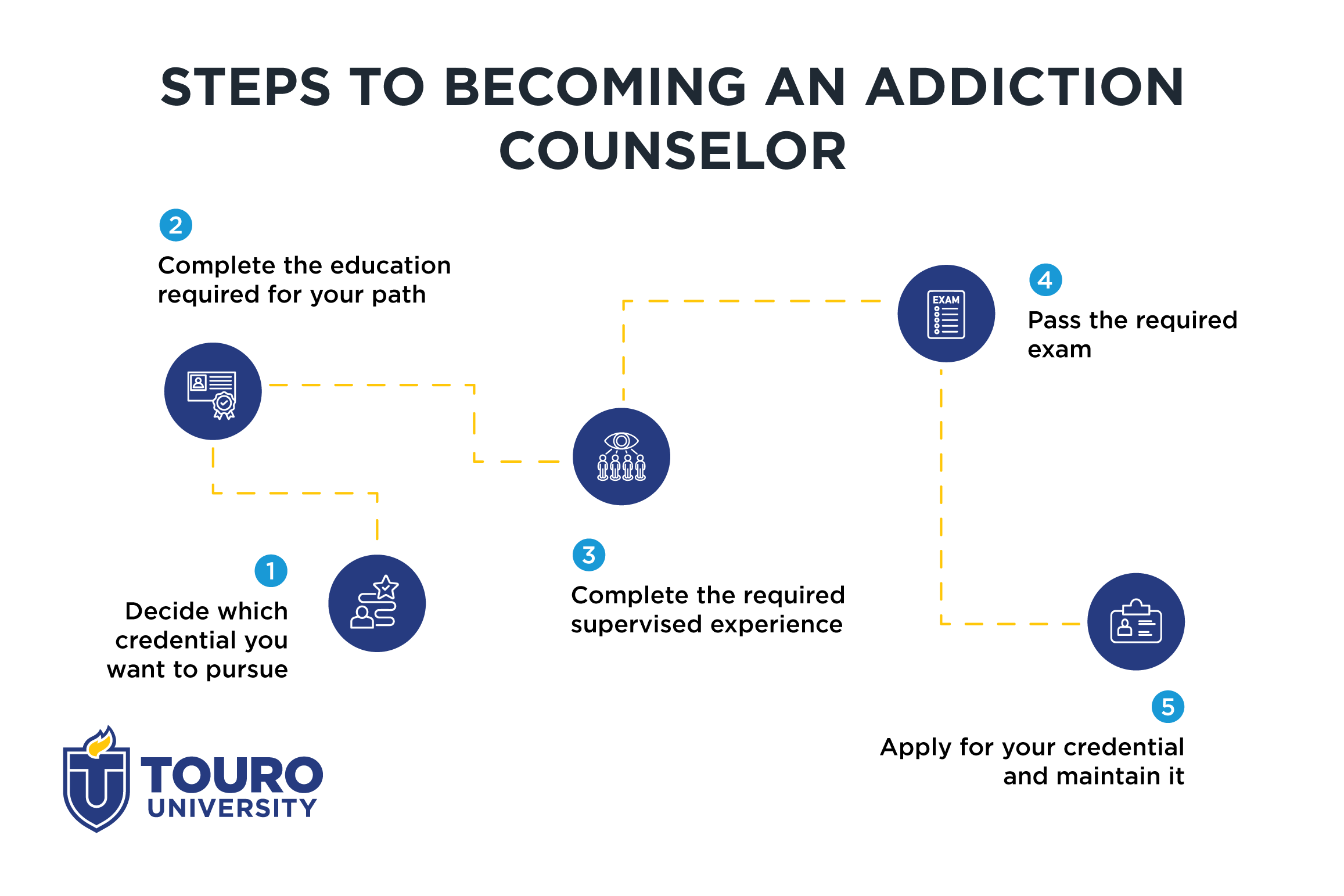
Step 1: Decide which credential you want to pursue
Addiction counseling generally involves two different credentialing routes, although individual states organize them differently.
An addiction-specific certification or credential qualifies counselors to provide substance use disorder services within the scope established by the state or certifying organization. Education requirements vary considerably. BLS notes that some substance abuse counseling positions require only a high school diploma, while others require a bachelor’s or master’s degree.
A clinical counseling license, such as an LPC or LPCC, has broader requirements. Mental health counselors typically need a master’s degree and supervised clinical training, and BLS notes that counselors in private practice must be licensed.
Choose based on the work you eventually want to do. If your goal is independent clinical practice or treating co-occurring mental health conditions within a licensed counseling scope, you will generally need the graduate-level licensure route. If you want to work specifically in substance use disorder treatment, your state may offer an addiction counselor credential with different education requirements.
Step 2: Complete the education required for your path
Education requirements depend on the credential. For addiction-specific credentials, some jurisdictions provide routes for applicants without a bachelor’s degree. IC&RC’s Alcohol & Drug Counselor standards illustrate how education can affect later experience requirements. Its minimum standards require 6,000 supervised work hours with a high school diploma, compared with 4,000 for a relevant bachelor’s degree and 2,000 for a relevant master’s degree. Individual IC&RC member boards may set additional requirements.
A bachelor’s degree in psychology, human services, social work, or another behavioral health field can provide preparation for addiction-related work and is also the usual prerequisite for graduate study. Students starting at this level can explore TUW’s BA in Psychology with a Human Services concentration.
If you are pursuing professional counseling licensure, graduate education becomes central. BLS says mental health counselors typically need a master’s degree and an internship. State boards then set the exact degree, coursework, practicum, and licensing requirements.
TUW’s online Master of Arts in Counseling with an Addiction Counseling Specialization offers two tracks:
- 60-credit MAC Track: 14 core courses, two practicum courses, and four clinical internship courses
- 72-credit Advanced Topics Track: the 60-credit curriculum plus four advanced courses required for the California-focused track
Both tracks include 100 practicum hours and 600 internship hours, for 700 hours of clinical training. The program is delivered online in eight-week courses with no university residency requirement, although students must secure an approved site for face-to-face practicum and internship training.
Both tracks were developed in alignment with CACREP standards. The 72-credit Advanced Topics Track is approved by the California Board of Behavioral Sciences for students pursuing California LPCC licensure.
Step 3: Complete the required supervised experience

Supervised experience is a major part of both addiction counselor certification and clinical licensure, but there is no national hour requirement.
The amount may depend on your education. Under IC&RC’s minimum ADC standards, for example:
- High school diploma or equivalent: 6,000 supervised work hours
- Relevant associate degree: 5,000 hours
- Relevant bachelor’s degree: 4,000 hours
- Relevant master’s degree or higher: 2,000 hours
These are not universal state requirements. Member boards may require additional education, supervision, or experience.
Clinical counseling licensure has its own requirements. In California, for example, LPCC applicants must complete 3,000 hours of supervised post-degree professional experience over at least 104 weeks.
Graduate programs can include clinical training before licensure. TUW’s MA in Counseling includes two practicum courses and four internship courses, totaling 700 clinical training hours. These degree requirements should not be confused with any post-degree experience your state may require for licensure.
Step 4: Pass the required exam
The exam depends on the credential and jurisdiction. Some addiction counselor credentialing boards use examinations developed by IC&RC. Its Alcohol & Drug Counselor credential requires the ADC Examination, while its master’s-level Advanced Alcohol & Drug Counselor credential requires the AADC Examination. State or member-board requirements may go beyond IC&RC’s minimum standards.
Professional counseling licenses use different examinations. In California, someone pursuing LPCC licensure must pass the California Law and Ethics Exam and, after completing the required supervised experience and receiving BBS approval, the National Clinical Mental Health Counseling Examination (NCMHCE).
Check your state or certifying organization before preparing for an exam.
Step 5: Apply for your credential and maintain it
Once you have met the education, experience, and examination requirements, submit your application to the board or certifying organization responsible for your credential. Required documentation may include transcripts, supervised-experience verification, exam results, and background-check information.
Renewal requirements also vary. As one national example, IC&RC’s ADC and AADC minimum standards require 40 hours of continuing education every two years, although member boards may use different renewal intervals.
Moving to another state may require a new application. IC&RC facilitates reciprocity for certain credentials between participating member boards, but reciprocity is not automatic. Both jurisdictions must offer the credential at the reciprocal level, and the receiving board may have additional requirements.
Addiction counselor certification vs. clinical licensure
Because credential names and requirements vary significantly by state, there is no single national hierarchy for addiction counselor credentials. A more useful comparison is the type of credential and the scope it is designed to support.
| Credential path | Education | Experience | What to know |
|---|---|---|---|
| Registration or trainee status | Varies by state or certifying organization | Usually completed while working toward certification | Allows someone to begin qualifying work under applicable supervision in jurisdictions that use registration |
| Addiction counselor certification | May range from high school through graduate education | Varies considerably; education may reduce required hours | Focuses specifically on substance use disorder counseling |
| Advanced addiction credential | Often requires graduate education | Additional supervised work and supervision may be required | Requirements and scope depend on the credentialing organization and jurisdiction |
| Professional counseling license | Typically requires a qualifying master’s degree | State-required supervised clinical experience | Broader clinical counseling scope; licensure is generally required for independent private practice |
How long does it take to become an addiction counselor?

The time required to become an addiction counselor depends on the level of education and supervised experience tied to the credential you pursue.
An addiction-specific route that does not require a four-year degree may allow you to begin qualifying work sooner, but certification can still require substantial supervised experience. Under IC&RC’s ADC standards, for example, an applicant with a high school diploma needs 6,000 supervised work hours, while a relevant bachelor’s degree reduces that minimum to 4,000 hours.
Clinical licensure takes longer because it includes graduate education and post-degree supervised experience. In California, the LPCC pathway requires a qualifying graduate degree followed by 3,000 supervised post-degree hours over at least 104 weeks.
For students considering TUW, the 60-credit MAC Track can typically be completed in about two years of full-time study, while the 72-credit Advanced Topics Track is designed for about 2.5 years full time. Actual completion time can vary based on transfer credits and the ability to secure an approved clinical placement.
How much do addiction counselors earn?
The U.S. Bureau of Labor Statistics combines substance abuse counselors with behavioral disorder and mental health counselors, so its wage figure is broader than addiction counseling alone.
Workers in this combined occupation earned a median annual wage of around $60,000. Employment is projected to grow 18% from 2025 to 2035, with about 50,500 openings projected each year.
Pay also differs by work setting. In May 2025, median annual wages in several major employing industries were:
- Hospitals: $63,310
- Outpatient mental health and substance abuse centers: $58,750
- Individual and family services: $58,440
- Residential mental health and substance abuse facilities: $49,660
BLS also reports that the lowest 10% of workers in the combined occupation earned less than $38,940, while the highest 10% earned more than $97,590. These figures should be used as occupational benchmarks rather than as expected pay for a particular addiction counselor credential.
How do you become an addiction counselor in California?
California separates substance use disorder counselor certification from professional clinical counseling licensure.
For people providing counseling services in alcohol and other drug programs licensed or certified by the state, the California Department of Health Care Services requires counselors who are not already licensed or certified to register with a DHCS-approved certifying organization. DHCS itself does not issue the counselor certification.
California currently recognizes certifying programs through CAADE, CADTP, and CCAPP. Registered counselors have five years from initial registration to become certified.
California also introduced new education requirements under AB 2473. A person who first registers on or after January 1, 2026 must complete 80 hours of approved education, including required core competency topics, within six months of registration. Additional requirements for full certification are determined through the approved certifying organization.
The separate clinical counseling route runs through the California Board of Behavioral Sciences. California LPCC applicants need a qualifying graduate degree and 3,000 post-degree supervised hours over at least 104 weeks, along with the required exams.
TUW students pursuing this California LPCC route should select the 72-credit Advanced Topics Track, which is the BBS-approved track in the MA in Counseling program.
The bottom line
Becoming an addiction counselor starts with identifying the credential required for the work you want to do in your state. Addiction-specific certification may have a different education threshold from professional counseling licensure, while independent clinical practice generally requires graduate education and a state license.
Check your state board or approved certifying organization before choosing a degree or training program. Requirements for education, supervised work, exams, and renewal are set at the jurisdiction level.
If your goal includes graduate-level counseling preparation, explore TUW’s online Master of Arts in Counseling with an Addiction Counseling Specialization. The program offers a 60-credit track and a 72-credit Advanced Topics Track approved by the California BBS. You can also review tuition and financial aid options or connect with admissions.
Frequently asked questions (FAQs)
Can you become an addiction counselor without a degree?
In some states and positions, yes. BLS says substance abuse and behavioral disorder counselors typically need at least a bachelor’s degree, but some positions require only a high school diploma. State certification requirements determine which services you can provide and what supervision is required.
IC&RC’s ADC standards, for example, provide a high-school-level pathway but require 6,000 hours of supervised work experience. A higher degree reduces the minimum experience requirement under those standards.
What is the difference between a certified addiction counselor and a licensed counselor?
An addiction counselor certification is a credential focused on substance use disorder counseling and is issued under the rules of a state or recognized certifying organization. Requirements and permitted scope vary by jurisdiction.
A professional counseling license such as an LPC or LPCC generally requires a qualifying master’s degree, supervised clinical experience, and state examinations.
Is an addiction counselor the same as a substance abuse counselor?
The terms are often used for similar work, but credential titles are not standardized nationally. “Substance use disorder counselor,” “addiction counselor,” and “alcohol and drug counselor” may appear in state regulations or job postings depending on the jurisdiction.
BLS uses the broader occupational category substance abuse, behavioral disorder, and mental health counselors, which includes workers beyond addiction counseling. For that reason, BLS salary and employment figures should not be treated as data for one specific addiction counselor credential.
How do you become an addiction counselor in California?
If you provide counseling services in a DHCS-licensed or certified alcohol and other drug program and are not already licensed or certified, you must register with a DHCS-approved certifying organization. You then work toward that organization’s certification requirements and must become certified within five years of your initial registration.
For registrations beginning on or after January 1, 2026, California also requires 80 hours of approved education within the first six months of registration. Clinical counseling licensure is a separate route regulated by the BBS.
Is becoming an addiction counselor worth it?
That depends on the kind of work you want and the credential you plan to pursue. BLS projects 18% employment growth from 2025 to 2035 for the broader occupation that includes substance abuse, behavioral disorder, and mental health counselors, compared with 3% for all occupations.
The work can also be demanding, so looking at both the employment outlook and the day-to-day demands can help you decide whether the field fits your goals.