


How to Become a Probation Officer: Steps, Skills, and Salary
Key Takeaways
- A bachelor’s degree is the typical entry-level education for probation officers, although exact education requirements vary by agency.
- Relevant degree fields may include criminal justice, criminology, psychology, sociology, and other areas that build knowledge of legal systems, human behavior, and community services.
- Probation officer applicants may need to complete written, oral, or psychological examinations, background checks, drug testing, and other screening required by the hiring agency.
- Most probation officers complete government-sponsored training after they are hired, and some agencies also require certification or a trainee period before permanent appointment.
- Probation officers and correctional treatment specialists earn a median annual wage of $66,270, and BLS projects about 7,900 job openings each year from 2025 to 2035.
Probation officers combine public safety responsibilities with rehabilitation-focused work, supervising people in the community while helping them meet court requirements and access services that can support successful reintegration. Entry requirements differ across state and local agencies, while federal probation and pretrial services operate under their own hiring standards.
For students, career changers, and working adults interested in this area of criminal justice, the steps below explain the education, experience, screening, and training involved, along with career progression and current salary and employment data.
How to become a probation officer: Step by step
Preparing for a probation officer career typically starts with a bachelor’s degree, followed by meeting the hiring standards of the agency where you apply. Relevant experience may strengthen your application, and most officers complete government-sponsored training after they are hired. Requirements differ across state and local agencies and the federal court system.
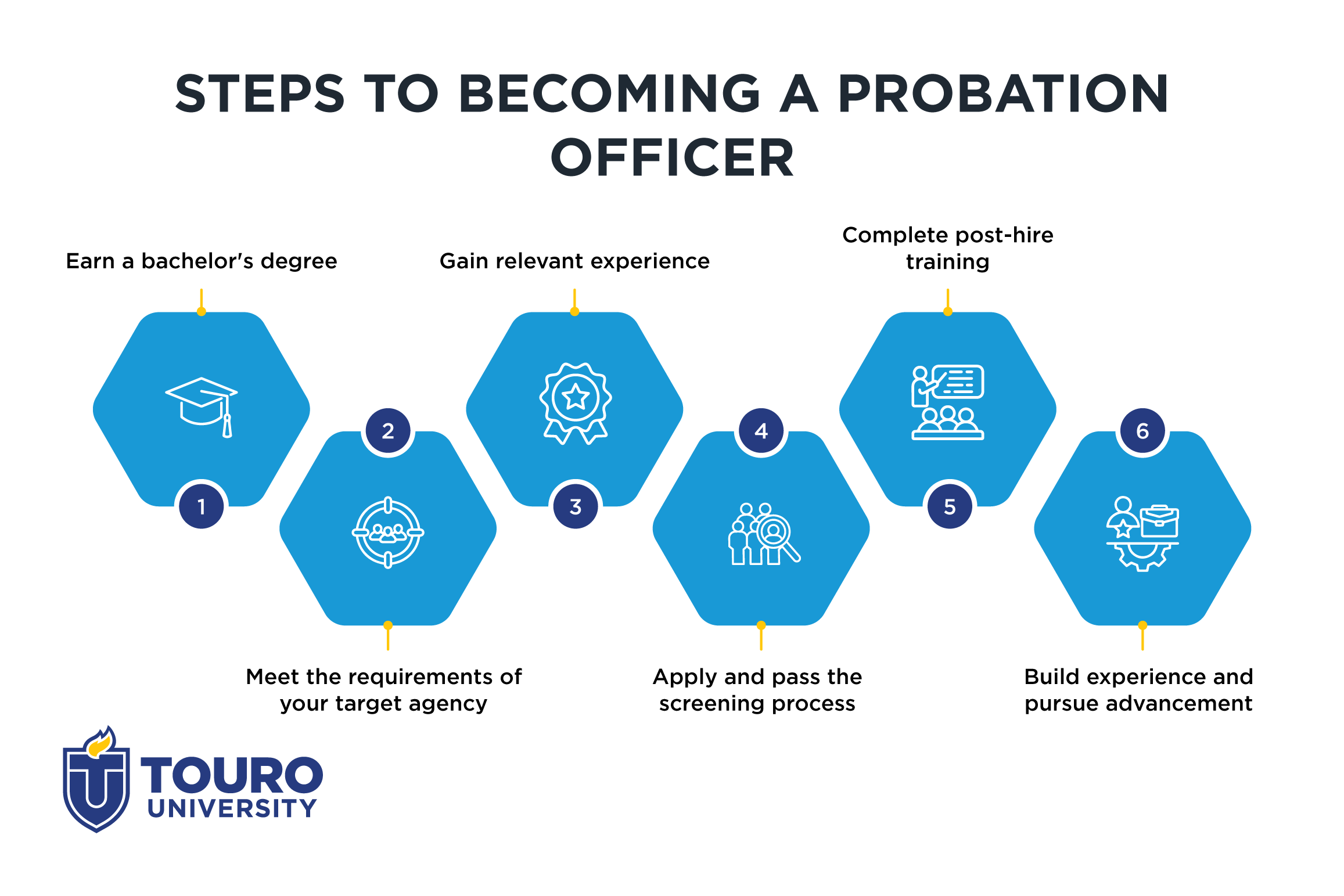
Step 1: Earn a bachelor’s degree
A bachelor’s degree is the typical entry-level education for probation officers. Common fields include criminal justice, other security and protective service fields, social sciences, and psychology, although individual agencies may accept a wider range of majors.
At TUW, our online BSBA with a Criminal Justice concentration covers the criminal justice system, criminal processes and procedures, and forensic psychology. Our BA in Psychology with a Human Services concentration provides another option for students interested in human behavior and community services. The Bachelor of Arts in Social Work combines online coursework with required field education and lists probation officers among its potential career paths.
Step 2: Meet the requirements of your target agency
Eligibility requirements vary, so check the specific probation department or court where you plan to apply. According to the Bureau of Labor Statistics (BLS), some agencies require applicants to be at least 21 and may require a valid driver’s license.
Federal probation and pretrial services use additional standards. Applicants for officer positions need at least a bachelor’s degree, and first-time appointees covered by federal law-enforcement retirement provisions generally must be appointed before their 37th birthday, subject to limited exceptions for prior qualifying federal law-enforcement service.
Step 3: Gain relevant experience
Relevant experience can strengthen your application, particularly for positions that involve case management, counseling, or community supervision. Useful experience may come from internships with probation departments or courts, social services, substance-use treatment, victim services, or other roles that involve working directly with people in structured support settings.
Federal requirements vary by classification level. Some U.S. probation officer positions require specialized experience, while certain graduate education or strong academic achievement can substitute for some experience requirements at lower classifications.
Step 4: Apply and pass the screening process
The hiring process depends on the agency. Candidates may be required to complete competency exams, interviews, a criminal background check, drug testing, medical screening, or psychological evaluation. Federal probation officers are also subject to medical requirements and a background investigation.
Review the job announcement carefully before applying so you know which documents, examinations, and screening steps are required for that specific position.
Step 5: Complete post-hire training
Most probation officers complete a government-sponsored training program after they are hired. Training may cover case supervision, legal procedures, report writing, officer safety, and other responsibilities associated with the role.
Depending on the jurisdiction, officers may also need to pass a certification test or work as trainees for up to one year before receiving a permanent appointment. Agencies that authorize officers to carry firearms may require additional weapons training.
Step 6: Build experience and pursue advancement
With experience and strong performance, probation officers may move into supervisory positions or specialize in areas such as juvenile cases, domestic violence, substance use, or other focused caseloads. Graduate education may also support advancement in some settings.
For federal positions, a closely related master’s degree can substitute for specialized experience at certain classification levels. Students interested in broader leadership or public-sector roles can explore our online Master of Science in Human Services or Master of Arts in Public Administration. Both programs are 100% online and designed for professionals working across human services, government, nonprofit, and public-sector settings.
Probation officer requirements by employer type
Probation officer requirements depend heavily on the agency and population served. State and local departments set their own standards for adult and juvenile roles, while federal probation and pretrial services follow a separate national framework.
| Employer type | Education | Experience | Other common requirements |
|---|---|---|---|
| State or local adult probation | A bachelor’s degree is typical; accepted fields vary by agency | Relevant casework, social services, corrections, or internship experience may help | Agencies may require exams, background checks, post-hire training, certification, or a trainee period |
| Juvenile probation | A bachelor’s degree is common; requirements vary by jurisdiction | Youth services, counseling, education, or social services experience may be relevant | Hiring and training requirements are set by the state, county, or local agency |
| Federal probation and pretrial services | At least a bachelor’s degree; specific vacancies may identify relevant fields | Requirements depend on classification level; some positions require specialized experience, while qualifying graduate education may substitute at certain levels | First-time covered appointees generally must be appointed before age 37 and must complete a medical exam, drug test, and background investigation |
Adult and juvenile probation roles may involve many of the same core responsibilities, but juvenile officers work specifically with young people and their families, which can make experience in youth services or counseling particularly relevant. Federal positions follow more standardized eligibility and screening rules, although education and experience requirements still vary by classification and vacancy.
How long does it take to become a probation officer?
For someone starting with no college education, the bachelor’s degree is usually the longest part of the process and typically takes about four years of full-time study. After graduation, the timeline depends on the hiring agency, since screening, background checks, and post-hire training can add several months or longer.
BLS classifies probation officers as requiring moderate-term on-the-job training, and most officers complete government-sponsored training after they are hired. Some agencies may also require a certification test or a trainee period of up to one year before permanent appointment.
TUW offers six start dates each year and eight-week terms, giving students several opportunities to begin throughout the year. Our BA in Psychology with a Human Services concentration also offers an accelerated admissions process and accepts up to 90 eligible transfer credits.

Probation officer salary and job outlook
According to the U.S. Bureau of Labor Statistics, probation officers and correctional treatment specialists earn a median annual wage of $66,270. Median pay is $70,260 in local government and $66,270 in state government, the two main government settings reported by BLS.
For the probation officer title specifically, average annual pay in the U.S. is currently estimated at about $63,000, with most reported salaries falling between approximately $45,500 and $74,500.
These figures are based on job postings and third-party salary data, so they are best treated as a current market reference.
BLS projects employment of probation officers and correctional treatment specialists to grow 3% from 2025 to 2035, with about 7,900 openings projected each year. Many of those openings are expected to come from workers transferring to other occupations or leaving the workforce, including retirement. Employment growth also depends heavily on state and local government funding for probation and parole systems.
Actual pay varies by location, employer, experience, and level of responsibility.
Probation officer vs. parole officer: What’s the difference?
Probation officers supervise people who have been placed on probation, generally as an alternative to incarceration, while parole officers work with people who have been released from prison and are serving a period of parole. Both roles involve community supervision, monitoring compliance with release conditions, and connecting people with services that support rehabilitation.
BLS notes that some states assign probation and parole responsibilities to the same workers. In other jurisdictions, they are separate positions with their own hiring and training requirements. Probation officers may also specialize in adult or juvenile cases, depending on the agency.
Skills successful probation officers need
Probation officers manage multiple cases while communicating with clients, families, courts, and treatment providers. BLS identifies several skills that are especially important in this work:
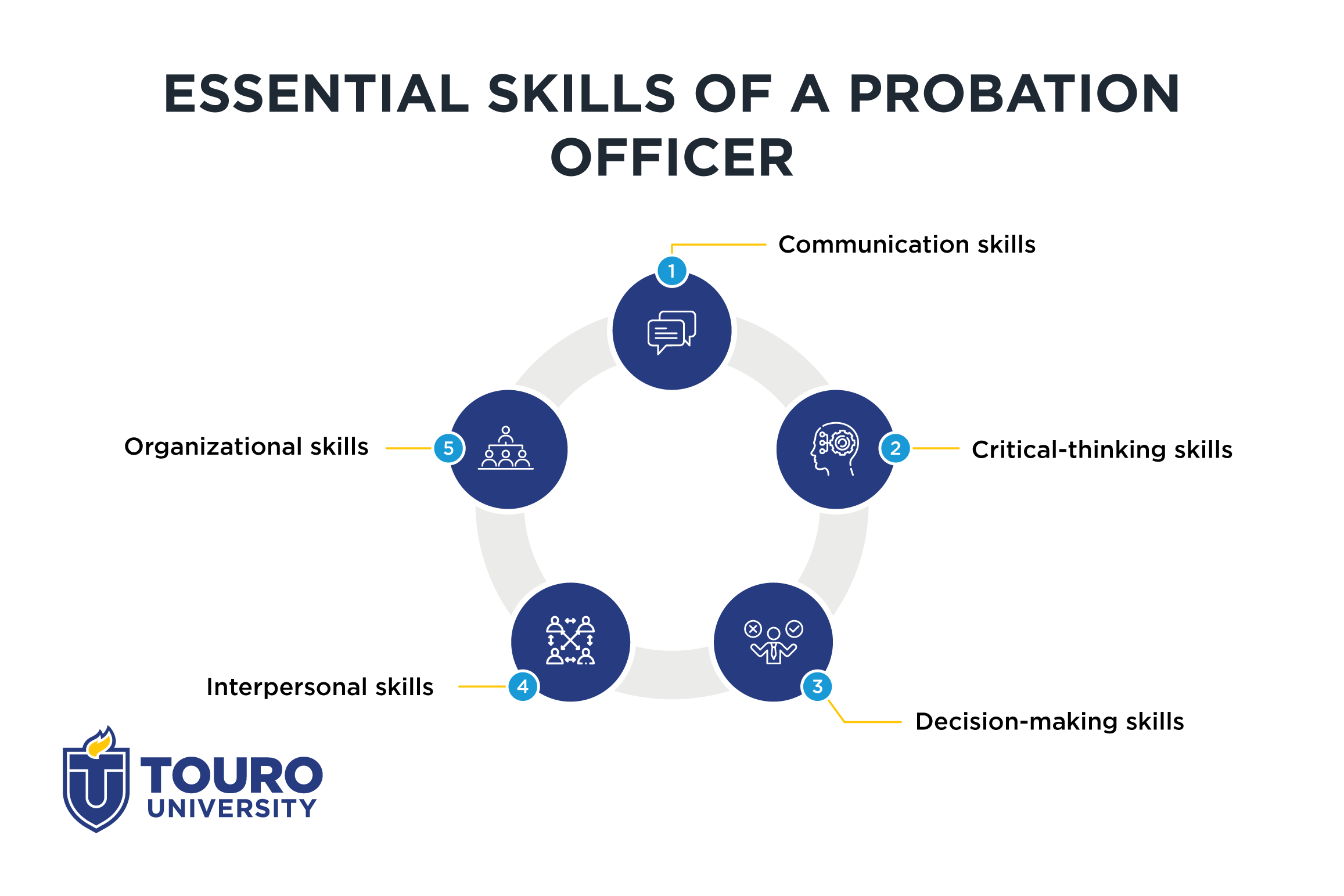
- Communication skills: Officers need to explain information clearly to clients and families and communicate effectively with judges, lawyers, and treatment providers.
- Critical-thinking skills: Evaluating a person’s circumstances and needs helps officers identify appropriate services and rehabilitation resources.
- Decision-making skills: Officers make judgments about supervision and rehabilitation plans based on the circumstances of each case.
- Interpersonal skills: Building productive working relationships is important when dealing with people who may be hostile, resistant, or facing difficult circumstances.
- Organizational skills: Officers often manage multiple cases at once, making accurate records, deadlines, and ongoing case monitoring essential.
The bottom line
A probation officer career usually begins with a bachelor’s degree, followed by the hiring and training requirements set by the agency where you apply. Because those requirements vary across state, local, and federal systems, reviewing current job announcements early can help you choose relevant education and experience before you apply.
Touro University Worldwide is a nonprofit university accredited by the WASC Senior College and University Commission (WSCUC) and offers online programs designed for working adults. If you’re considering criminal justice, explore our BSBA with a Criminal Justice concentration and learn more about criminal justice careers. You can also connect with admissions to request information or begin an application.
Frequently asked questions (FAQs)
What degree do you need to be a probation officer?
A bachelor’s degree is the typical entry-level education for probation officers. Relevant fields may include criminal justice, psychology, social sciences, and other subjects accepted by the hiring agency, so always check the requirements of the positions you plan to pursue.
Can I become a probation officer with an online degree?
Yes. An online bachelor’s degree can meet the education requirement for probation officer positions when the degree and institution satisfy the hiring agency’s standards. You should confirm the education requirements in the specific state, county, or federal job announcement before applying.
How hard is it to become a probation officer?
The process can be demanding because applicants may need to complete exams, background checks, drug testing, interviews, and other agency-specific screening before completing post-hire training.
How do you become a juvenile probation officer?
Juvenile probation requirements vary by jurisdiction, but a bachelor’s degree is commonly required. Experience or coursework involving young people, counseling, social services, or related areas may strengthen your preparation, depending on the agency and position.
Is being a probation officer worth it?
That depends on your career goals and your interest in community supervision and rehabilitation. The work can be demanding, but helping people meet court requirements and make progress in their lives can also be rewarding. From a career perspective, probation officers and correctional treatment specialists have a median annual wage of $66,270, with about 7,900 openings projected each year from 2025 to 2035.