


Social Worker Salary in California: 2026 Pay by Specialty
Key takeaways
- Social worker pay in California varies considerably by specialty. Healthcare social workers earn a median annual wage of $89,660, mental health and substance abuse social workers earn $79,000, and child, family, and school social workers earn $65,200.
- California median wages for healthcare social workers and mental health and substance abuse social workers are well above the corresponding national medians, while child, family, and school social worker pay is closer to the national figure.
- Location also affects pay. Child, family, and school social workers earn a median of $87,600 in San Jose-Sunnyvale-Santa Clara, compared with $59,770 in San Diego-Chula Vista-Carlsbad.
California social worker salaries vary considerably by specialty. According to the U.S. Bureau of Labor Statistics, healthcare social workers earn a median annual wage of $89,660 in California, while child, family, and school social workers earn $65,200.
For aspiring social workers, current BSW and MSW students, and career changers in California, it’s important to understand that salary can differ based on specialty, location, education, licensure, and work setting. Below, you can compare California pay across social work specialties and metro areas, review the job outlook, and learn about factors that may affect earning potential.
What is the average social worker salary in California?
BLS reports social worker wages across several specialties, and California pay varies considerably between them. Healthcare social workers earn a median annual wage of $89,660 in California, compared with a national median of $67,880. Mental health and substance abuse social workers earn $79,000 in California, compared with a national median of $60,280.
| Specialty | California median | U.S. median |
|---|---|---|
| Healthcare social workers | $89,660 | $67,880 |
| Mental health and substance abuse social workers | $79,000 | $60,280 |
| Child, family, and school social workers | $65,200 | $59,550 |
| Social workers, all other | $63,010 | $71,900 |
Source: U.S. Bureau of Labor Statistics, Occupational Employment and Wage Statistics
California wages exceed the national median in three of these four categories. Social workers classified as “all other” earn a median of $63,010 in California, compared with $71,900 nationally.
What affects social worker pay in California
Social worker pay in California can vary based on specialty, location, education and licensure, and employer. The difference between the highest- and lowest-paid specialties in the California data above is more than $26,000 a year, and wages can also vary considerably across metropolitan areas and work settings.
Specialty can create a significant pay difference

California wage data show clear differences between social work specialties. Healthcare social workers have the highest median among the four categories listed above, while child, family, and school social workers have a lower median. These occupations also differ in their responsibilities, populations served, and common employment settings.
For those interested in child welfare, learning more about the child and family social worker career can provide additional context on the work, education, and career options in this area.
Your metro area shifts pay
BLS metropolitan wage data show substantial differences in pay for child, family, and school social workers across California.
| Metro area (child, family, and school social workers) | Median annual wage | Employment |
|---|---|---|
| San Jose-Sunnyvale-Santa Clara | $87,600 | 2,120 |
| San Francisco-Oakland-Fremont | $72,020 | 5,840 |
| Los Angeles-Long Beach-Anaheim | $71,250 | 26,220 |
| Sacramento-Roseville-Folsom | $63,270 | 3,550 |
| Riverside-San Bernardino-Ontario | $63,230 | 5,810 |
| San Diego-Chula Vista-Carlsbad | $59,770 | 3,820 |
In this comparison, San Jose-Sunnyvale-Santa Clara has the highest median at $87,600, while San Diego-Chula Vista-Carlsbad has the lowest at $59,770. These differences show why statewide salary figures may not reflect what social workers earn in a particular local market.
BLS data also show considerable geographic variation for healthcare social workers. Location is therefore an important factor to consider alongside specialty, employer, experience, and work setting when comparing salaries across California.
Education and licensure can affect career options
A bachelor’s degree in social work can prepare graduates for some entry-level social work positions, while clinical social workers must hold a master’s degree, complete supervised clinical experience, and obtain state licensure. BLS also identifies a master’s degree as the typical entry-level education for healthcare social workers and mental health and substance abuse social workers.
BLS does not publish a separate salary for the LCSW credential. The California specialty medians above can provide useful occupational benchmarks, but they should not be treated as LCSW-specific salaries. BLS wage estimates also exclude self-employed workers, so earnings from self-employed private practice are not included. For those beginning with a bachelor’s degree, our entry-level social work jobs overview provides examples of possible roles.
Hospitals pay more than nonprofits
National BLS data show clear differences in social worker wages by industry. Hospitals have a median annual wage of $77,440, followed by educational services at $68,850, state and local government excluding education and hospitals at $65,100, ambulatory healthcare services at $63,710, and individual and family services at $51,980.
In California, county child welfare and behavioral health departments are major employers, and nonprofits often pay on the lower end of this range, though they’re frequently where new social workers find the qualifying supervision needed for licensure.
Job outlook for social workers in California

Nationally, the BLS projects employment of social workers to grow 6% from 2025 to 2035, faster than the average for all occupations. About 69,100 openings are projected each year over the decade, including openings created by employment growth and workers leaving the occupation.
California projections also point to continued demand in specific social work specialties. Employment of child, family, and school social workers is projected to grow 14% from 2024 to 2034, from about 59,000 to 67,300 positions. The state is projected to have about 6,060 openings per year in this specialty over the same period.
How to increase your social worker salary in California
Earning potential can change as social workers gain education, licensure, specialized experience, and additional professional responsibilities.
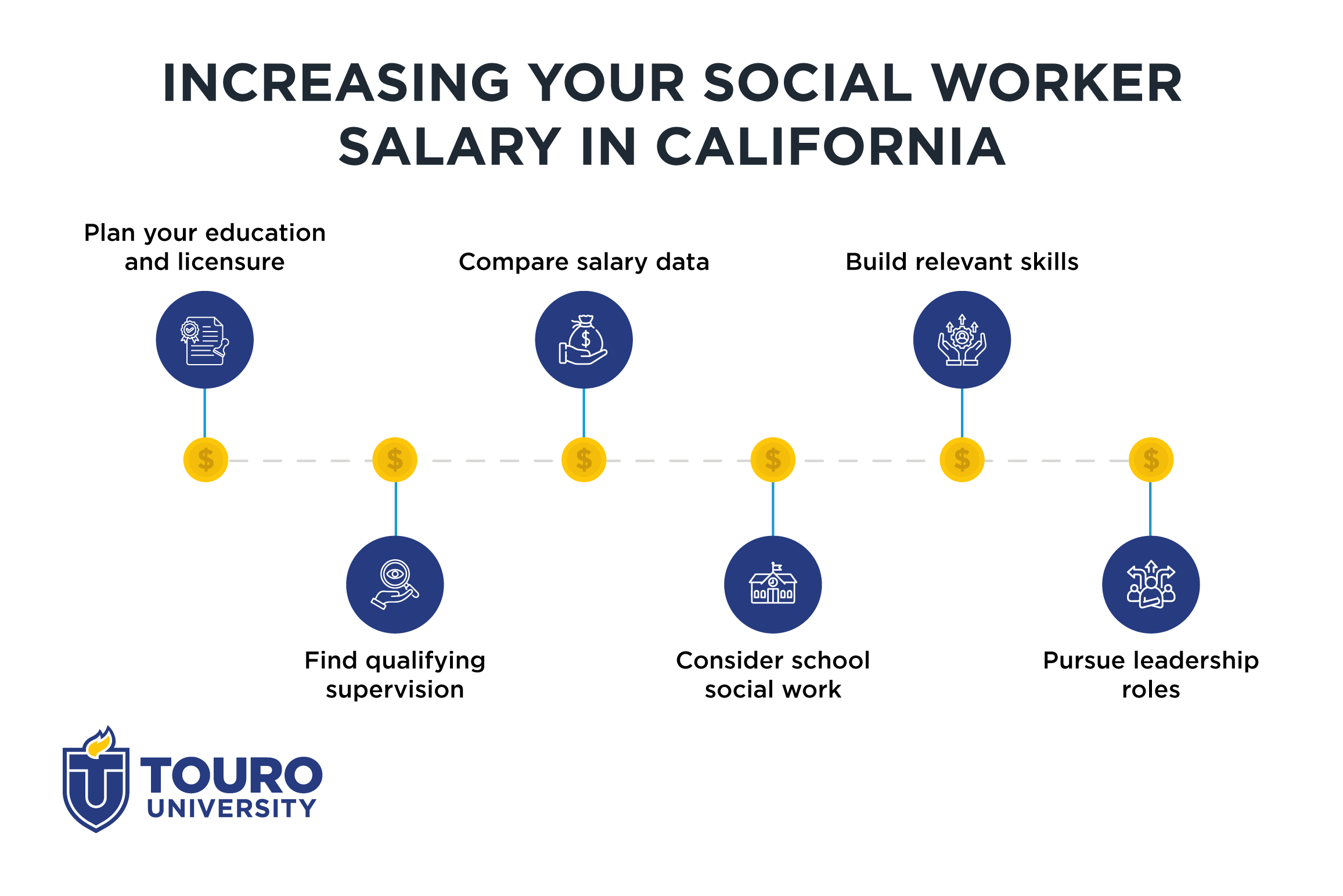
- Plan for the education and licensure your career requires: Some clinical social work positions require an MSW and state licensure, while other roles may be available with a bachelor’s degree. Reviewing the requirements for your intended specialty can help you plan your education and supervised experience.
- Look for qualifying supervision when pursuing clinical licensure: If you plan to become an LCSW, confirm that your position, supervisor, and clinical experience meet California’s requirements before beginning to accrue hours.
- Use salary data when evaluating offers: Compare compensation with BLS wage data for your specialty and metropolitan area, instead of relying on a statewide figure alone.
- Consider school social work if it matches your goals: California school social workers generally need a Pupil Personnel Services Credential with a School Social Work specialization. At TUW, the School Social Work concentration can provide undergraduate preparation in areas such as child welfare, youth at risk, and school social work, but it does not itself lead to the PPS credential.
- Develop skills relevant to your preferred area of practice. Experience in areas such as crisis intervention, behavioral health, child and family services, or multilingual services may broaden the positions available to you.
- Consider supervisory or program leadership roles as you gain experience: Additional responsibilities can expand career options, although compensation depends on the employer, role, and setting.
Grow your earning potential
California social worker salaries vary considerably by specialty, location, work setting, experience, education, and licensure. Healthcare social workers have the highest median wage among the California specialties compared above, while advanced clinical roles may require an MSW and state licensure.
If you’re ready to start building toward this career, our online Bachelor of Arts in Social Work provides preparation for entry-level social work and human services roles as well as graduate study. Students considering the program can review current tuition, explore financial aid options, and contact admissions for more information.
Frequently asked questions (FAQs)
What is the starting salary for a social worker in California?
In California, the 10th-percentile annual wage for child, family, and school social workers is $45,360, but this figure includes workers at the lower end of the wage distribution and should not be treated as an entry-level salary. BLS California wage data provide additional percentile information.
How much does a social worker make per hour in California?
Based on current BLS median annual wages, child, family, and school social workers in California earn the equivalent of about $31 per hour, while healthcare social workers earn about $43 per hour. Actual hourly compensation varies by specialty, employer, location, experience, and work schedule.
Who gets paid more in California, an LCSW or an LMFT?
There is no reliable BLS comparison between the two licenses. BLS tracks marriage and family therapists as an occupation but does not publish wages specifically for LCSWs, who may work across several social work categories. Pay for either credential can vary considerably by setting, specialty, location, and experience. Learn more about how to become a therapist in California when comparing these options.
Is social work a good career in California?
It can be a good fit for people whose goals align with social work practice. BLS projects 6% employment growth for social workers nationally from 2025 to 2035, while California projects stronger growth in some specialties. Salary, education requirements, work conditions, and career opportunities vary by specialty and setting.