


How to Become a Licensed Clinical Social Worker: 5 Steps
Key Takeaways
- A CSWE-accredited bachelor’s degree in social work provides a direct starting point for becoming a licensed clinical social worker (LCSW) and may qualify graduates for advanced standing in a Master of Social Work (MSW) program.
- Advanced-standing MSW programs can reduce graduate coursework to approximately 30 semester credits at some institutions, along with fewer additional field education hours. This can save time and tuition compared with a regular-standing MSW program.
- Becoming an LCSW also requires completing an accredited MSW, gaining supervised clinical experience, meeting examination requirements, and applying for state licensure.
- The U.S. Bureau of Labor Statistics reports a median annual wage of $61,780 for social workers overall, while healthcare social workers earn a median of $67,880 and social workers in hospitals earn a median of $77,440.
- The Social Work Licensure Compact has been enacted in 35 states, but multistate licenses are not yet available as implementation continues.
If you’re researching how to become a licensed clinical social worker (LCSW), earning a bachelor’s degree in social work from a program accredited by the Council on Social Work Education (CSWE) can be a cost-effective starting point. It may qualify you for advanced standing in a Master of Social Work (MSW) program, potentially reducing the time and tuition required for graduate study.
Becoming an LCSW still requires an MSW, supervised clinical experience, and meeting state-specific licensing requirements. Understanding these five steps can help you plan your education and identify opportunities to reduce the time and tuition costs of earning an MSW.
How to become a licensed clinical social worker: Step by step
Becoming an LCSW generally involves five steps, beginning with a bachelor’s degree and progressing through graduate education, supervised clinical experience, examinations, and state licensure.
Requirements for supervised experience, supervision, examinations, and even license titles, such as LCSW, LICSW, or LCSW-C, vary by state. Check with the appropriate state licensing authority for the requirements where you plan to practice.
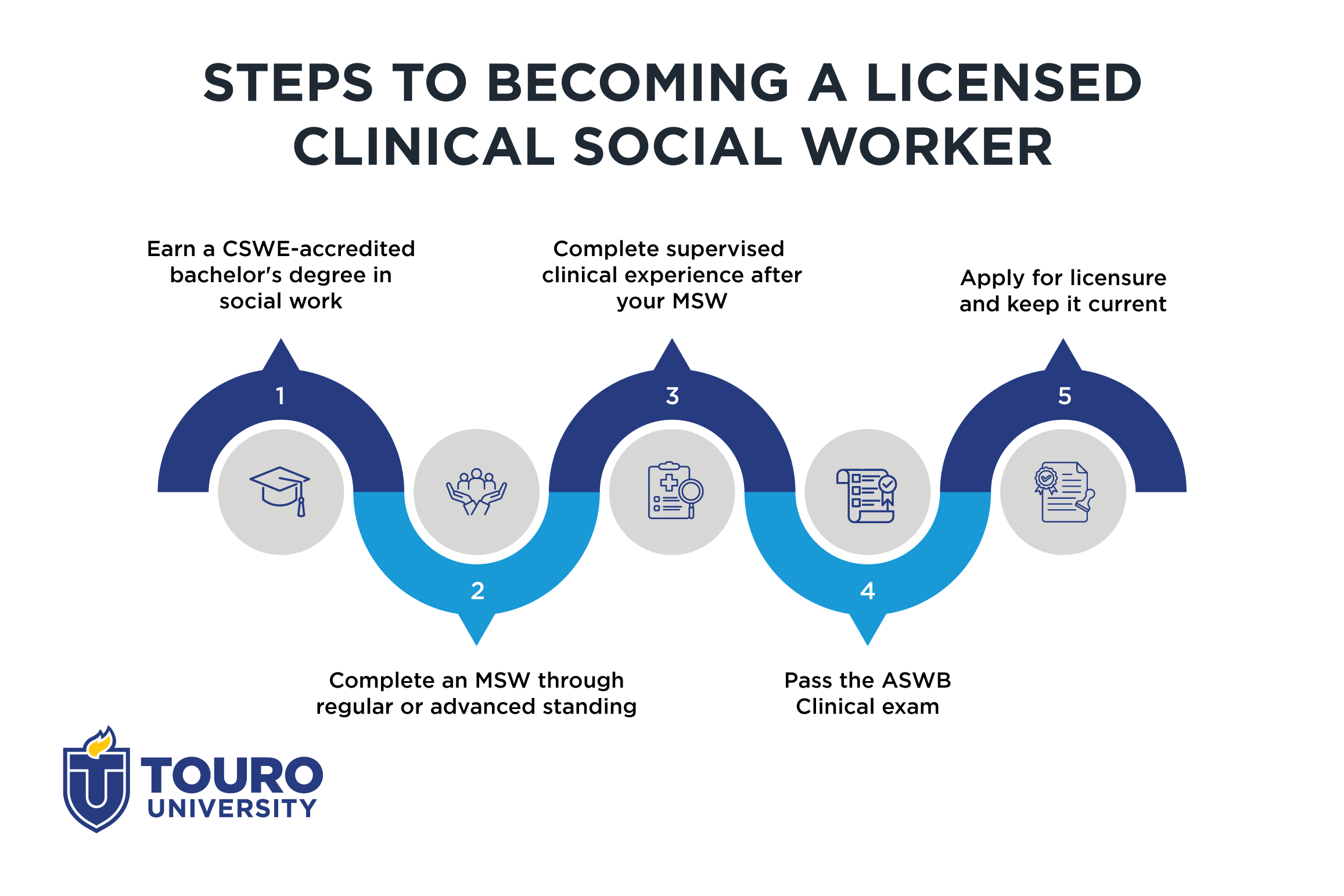
Step 1: Earn a CSWE-accredited bachelor’s degree in social work
A bachelor’s degree in social work from a CSWE-accredited program is the most direct undergraduate route. It includes required field education and can qualify graduates for advanced standing in an MSW program. Students with bachelor’s degrees in other fields can also apply to many regular-standing MSW programs, subject to each program’s admission requirements.
Touro University Worldwide’s online Bachelor of Arts in Social Work is accredited by the Council on Social Work Education’s Commission on Accreditation. The 120-credit program combines eight-week online courses with required field education, accepts up to 90 eligible transfer credits, and offers six terms per year. Students complete 450 hours of field education across three 150-hour field terms.
Graduates may qualify for advanced-standing MSW programs, subject to each institution’s admission requirements. The bachelor’s degree also prepares students for entry-level social work and human services roles, although it does not lead directly to clinical social work licensure.
Step 2: Complete an MSW through regular or advanced standing
Clinical social work licensure generally requires an MSW from a CSWE-accredited program. However, your undergraduate degree can affect how much additional coursework and field education you need to complete.
MSW programs typically offer two options:
- Regular standing: Available to students with bachelor’s degrees in social work or other fields. These programs generally require about two years of full-time study and at least 900 hours of graduate-level field education.
- Advanced standing: Available to qualifying graduates of CSWE-accredited bachelor’s social work programs. Some programs require approximately 30 semester credits and can be completed in about one year of full-time study. Students also complete fewer additional field education hours because their undergraduate field education counts toward the combined requirement.
CSWE requires advanced-standing students to complete at least 900 field education hours across their accredited bachelor’s and master’s social work programs combined. Individual institutions may require additional hours.
By reducing the graduate coursework and additional field education required, advanced standing can lower the time and tuition costs associated with earning an MSW. Admission criteria, credit requirements, and field placements vary by institution, so compare individual programs before applying.
Step 3: Complete supervised clinical experience after your MSW

Completing an MSW does not by itself result in clinical licensure. After graduation, candidates must complete the supervised clinical experience required by the state where they plan to practice. Some states first require a provisional, associate, or other pre-clinical credential before those hours can be accrued.
Requirements vary considerably, but many states require about two to three years of post-MSW supervised experience. Required clinical hours, supervision hours, eligible work settings, and supervisor qualifications are determined by each licensing authority.
Before beginning supervised experience, confirm that both the position and supervisor meet your state’s requirements. Keep detailed records of clinical hours, supervision, dates, and required approvals throughout the process so the documentation is available when you apply for licensure.
Step 4: Pass the ASWB Clinical exam
Most states require the ASWB Clinical exam for clinical social work licensure. Some states also have additional examination requirements. California, for example, requires a Law and Ethics Exam, while Texas requires a Social Workers Jurisprudence Exam.
The ASWB exam format introduced on August 3, 2026, includes 122 multiple-choice questions: 110 scored questions and 12 unscored pretest questions. Candidates have a four-hour time limit, and the Clinical exam covers three content areas: values and ethics, assessment and planning, and intervention and practice.
In 2025, 75.7% of first-time Clinical exam candidates passed, based on 26,439 first-time exams administered.
Candidates generally must receive approval from their state licensing authority before registering with ASWB. Check your state’s requirements to determine when you become eligible to take the exam and whether additional examinations are required.
Step 5: Apply for licensure and keep it current
Once you have completed your state’s education, supervised experience, and examination requirements, submit your licensure application with the required documentation. Depending on the state, this may include verification of supervised hours, supervisor forms, examination results, fees, and a background check.
After becoming licensed, you must maintain the credential according to your state’s renewal and continuing education requirements. Renewal periods and required continuing education hours vary by jurisdiction.
Clinical licensure may allow social workers to practice independently and may expand opportunities in private practice, clinical supervision, and insurance-based services. The exact scope of practice and any additional requirements depend on state law, professional regulations, and payer or employer policies.
LCSW requirements by state
Each state’s licensing authority sets its own requirements for supervised experience, supervision, examinations, and clinical licensure. Check the current requirements in the state where you plan to practice before choosing a program or beginning supervised experience.
| Example state | Who issues the license | Typical requirement (verify at time of application) |
|---|---|---|
| California | Board of Behavioral Sciences (BBS) | 3,000 hours of supervised post-degree experience over at least 104 weeks, plus the California Law and Ethics Exam and ASWB Clinical exam |
| New York | New York State Education Department (NYSED) | Three years of supervised clinical social work experience, including at least 2,000 client-contact hours over a minimum of 36 months, plus the ASWB Clinical exam |
| Texas | Behavioral Health Executive Council (BHEC) | At least 3,000 hours of supervised clinical experience over at least 24 months, including 100 hours of supervisory sessions, plus the ASWB Clinical exam and Texas Social Workers Jurisprudence Exam |
| Florida | Board of Clinical Social Work, Marriage & Family Therapy, and Mental Health Counseling | Two years of post-master’s supervised experience, including 1,500 hours of face-to-face psychotherapy and at least 100 hours of supervision over no fewer than 100 weeks, plus the ASWB Clinical exam |
A license issued by one state does not automatically authorize practice in another.
The Social Work Licensure Compact has been enacted in 35 states as of 2026. Multistate licenses are not yet available, however, as implementation work, including development of the compact’s data system, is still underway.
How long does it take to become an LCSW?
Becoming an LCSW typically takes about seven to nine years from the start of a bachelor’s degree, although students who qualify for advanced-standing MSW programs may complete their graduate education sooner.
A typical timeline includes:
- Bachelor’s degree: About four years, or potentially less with eligible transfer credits.
- MSW: About two years for regular-standing students or approximately one year for qualifying advanced-standing students.
- Post-MSW supervised clinical experience: About two to three years, depending on state requirements.
- Examination and licensure application: Additional time varies by state.
For students beginning with a bachelor’s degree, our CSWE-accredited BA in Social Work can be completed in approximately three and a half years with full-time, year-round study. The program uses eight-week online courses, offers six terms per year, and accepts up to 90 eligible transfer credits, which may reduce the amount of coursework remaining.

How much do licensed clinical social workers earn?
The U.S. Bureau of Labor Statistics does not publish a separate wage specifically for LCSWs. For social workers overall, the median annual wage is $61,780. The lowest 10% earn less than $42,790, while the highest 10% earn more than $100,090.
Within BLS social work categories, healthcare social workers earn a median annual wage of $67,880, while mental health and substance abuse social workers earn $60,280. Among the major industries listed by BLS, hospitals have the highest median wage for social workers at $77,440.
BLS wage estimates exclude self-employed workers, so they do not capture earnings from self-employed private practice. Employment of social workers is projected to grow 6% from 2025 to 2035, faster than the average for all occupations. Salary can vary based on location, work setting, experience, specialty, and licensure.
Start With a CSWE-Accredited Social Work Degree
A CSWE-accredited bachelor’s degree in social work can provide a cost-effective starting point for students planning to become licensed clinical social workers. Graduates may qualify for advanced-standing MSW programs, potentially reducing the time and tuition required for graduate study. Earning an MSW is the next educational requirement, followed by supervised clinical experience, licensing examinations, and other state-specific requirements.
Because requirements vary by state, reviewing the rules published by your state licensing authority can help you plan your education and supervised experience.
TUW’s CSWE-accredited online Bachelor of Arts in Social Work prepares students for generalist social work practice and graduate study, including potential eligibility for advanced-standing MSW programs. Explore our tuition, review financial aid options, or connect with admissions to learn more about the program.
Frequently asked questions (FAQs)
Can you become an LCSW without an MSW?
No. Clinical social work licensure requires graduate-level social work education. ASWB identifies an MSW from an accredited institution, post-degree supervised clinical experience, and the Clinical exam as the standard requirements for a clinical license. Individual state requirements should still be verified before selecting a program.
Is a licensed clinical social worker the same as a therapist?
An LCSW can work as a therapist and provide psychotherapy within the scope permitted by state law. LCSWs are trained specifically in social work, while other therapists may hold credentials in counseling, marriage and family therapy, psychology, or related fields. Our counseling vs. social work comparison explains some of these differences.
How hard is the LCSW exam?
The ASWB Clinical exam requires preparation across ethics, assessment and planning, and intervention and practice. In 2025, 75.7% of first-time Clinical exam candidates passed, based on 26,439 first-time exams administered. Individual preparation needs vary.
Can a bachelor’s degree in social work help you earn an MSW faster?
Yes. Graduates of CSWE-accredited bachelor’s social work programs may qualify for advanced-standing MSW programs, which can reduce graduate coursework to approximately 30 credits at some institutions. These programs also typically require fewer additional field education hours, potentially reducing the time and tuition costs of earning an MSW. Requirements vary by school.
Does an LCSW license transfer to another state?
Not automatically. Social work licenses are issued by individual states, and professionals may need to apply for licensure in another jurisdiction through endorsement or another state-specific process. The Social Work Licensure Compact has been enacted in 35 states, but multistate licenses are not yet available.
Is becoming an LCSW worth it?
It can be a good option for social workers who want to provide advanced clinical services or pursue independent clinical practice. Clinical licensure requires graduate education, supervised experience, examination requirements, and ongoing license maintenance, so the decision should account for your career goals, preferred work setting, and state requirements.