


How much do therapists make in California?
Key Takeaways
- “Therapist” is a broad term in California, and earnings vary by profession and license. Marriage and family therapists earn a national median annual wage of around $64,000; substance abuse, behavioral disorder, and mental health counselors earn approximately $59,000; mental health and substance abuse social workers earn around $60,000; and clinical and counseling psychologists earn close to $95,000.
- California has the highest employment level of marriage and family therapists in the country, making it one of the largest markets for professionals in the field.
- Work setting can have a noticeable effect on therapist pay. Salaries differ across government, outpatient care, community services, and other settings, while private-practice income depends on factors such as caseload, session rates, insurance reimbursement, and business expenses.
- Pre-licensed associates (AMFT, APCC, ASW) generally earn less while completing their 3,000 supervised hours; income typically increases after full licensure.
- Demand is strong: the BLS projects 17 percent growth for counselors and 13 percent for marriage and family therapists from 2024 to 2034, both much faster than average.
- Touro University Worldwide’s 100% online MA in Marriage and Family Therapy offers a California BBS-approved Marriage and Family Therapy Track for students working toward LMFT licensure, with a format designed to help working adults continue their careers while completing graduate study.
How much do therapists make in California? The answer depends on the type of license you hold, since “therapist” can refer to several mental health professions with different training requirements, scopes of practice, and earning potential. For students and career changers considering a therapy career in California, including working adults studying online, it helps to compare salaries by license type, understand what affects pay, and consider how education and licensure requirements influence long-term career options.
How much do therapists make in California?

Marriage and family therapists earn a national median annual wage of around $64,000, while substance abuse, behavioral disorder, and mental health counselors, a broader category relevant to Licensed Professional Clinical Counselors (LPCCs), earn approximately $59,000. Mental health and substance abuse social workers, a useful benchmark for Licensed Clinical Social Workers (LCSWs), earn around $60,000, while clinical and counseling psychologists earn close to $95,000.
Therapist salaries in California by license type
“Therapist” is a broad term, so this comparison focuses on four common California credentials: LMFT, LPCC, LCSW, and licensed psychologist.
| License / credential | National median wage (BLS) | California average salary estimate |
| LMFT (Licensed Marriage and Family Therapist) | About $64,000 per year | About $84,000 per year |
| LPCC (Licensed Professional Clinical Counselor) | About $59,000 per year | About $71,000 per year |
| LCSW (Licensed Clinical Social Worker) | About $60,000 per year | About $93,000 per year |
| Licensed psychologist (clinical and counseling psychologists) | About $95,000 per year | About $108,454 per year |
California has the highest employment level in the country for marriage and family therapists and also leads the country in employment in the broader Bureau of Labor Statistics (BLS) category used as a benchmark for LPCCs. The national figures above come from BLS occupational wage data, while the California figures are current market estimates based on employer job postings and third-party salary data.
Our online Master of Arts in Marriage and Family Therapy offers a California BBS-approved Marriage and Family Therapy Track for students pursuing LMFT licensure. Students who add the Counseling Licensure Track complete additional LPCC-focused coursework, with the combined track approved by the California Board of Behavioral Sciences for the educational requirements leading toward both LMFT and LPCC licensure.
What affects how much therapists make in California
Two therapists with the same license can still earn very different incomes. Here are the factors that influence how much each one earns.
Licensure status: associate vs. fully licensed
Associate Marriage and Family Therapists (AMFTs), Associate Professional Clinical Counselors (APCCs), and Associate Clinical Social Workers (ASWs) must practice under supervision until they complete the requirements for full licensure. Full licensure expands the roles and practice options available to therapists, including independent practice. When comparing available California salary estimates, fully licensed MFTs show higher earning potential than AMFTs.
Work setting: private practice, government, and outpatient care

Where a therapist works can have a direct effect on pay. BLS data shows a clear difference across major work settings for marriage and family therapists. The median annual wage is around $89,000 in state government and $73,000 in outpatient care centers, compared with about $59,500 in individual and family services and $59,000 in offices of other health practitioners.
Private practice works differently because income depends on session rates, caseload, insurance reimbursement, and business expenses. Depending on factors such as location, specialization, client volume, and fees, private-practice therapists may earn more than salaried clinicians.
Location within California
BLS metro-area wage data shows that marriage and family therapist pay varies across different parts of the state, so statewide figures do not always match what employers pay in a specific city or region.
Cost of living also affects the salary. California has some of the highest price levels in the country, and housing costs vary considerably across metro areas. When comparing job offers, consider both salary and local living costs to understand how much that income will actually cover. Regional price data from the Bureau of Economic Analysis (BEA) shows how price levels differ across California metro areas.
Experience and specialization
Experience often brings access to higher-level roles and greater earning potential. As therapists build their clinical experience, they may qualify for senior clinical, supervisory, training, or management positions with different responsibilities and pay levels. BLS data for marriage and family therapists also shows a wide earnings range, with the highest 10% earning more than $111,000 per year.
Specialized expertise can further affect what therapists earn, particularly in private practice or roles serving specific populations. Therapists who build expertise in areas such as trauma, couples therapy, bilingual services, or clinical supervision may qualify for roles with more focused responsibilities, take on additional duties, or set different rates in private practice.
Job outlook for therapists in California

The job outlook for therapists remains strong. BLS projects employment of substance abuse, behavioral disorder, and mental health counselors to grow 17% from 2024 to 2034, while marriage and family therapist employment is projected to grow 13% over the same period. Both rates are much faster than the average for all occupations.
California also has one of the country’s largest behavioral health workforces and continues to expand access to care. The state’s Behavioral Health Services Act includes measures to increase the behavioral health workforce, while the $6.4 billion Behavioral Health Bond is funding additional treatment facilities, community sites, and behavioral health infrastructure. These investments, combined with strong national employment growth, suggest continued demand for qualified therapists across California.
How to become a therapist in California and grow your earning power
For students pursuing LMFT licensure in California, the process includes completing a qualifying master’s degree, registering as an AMFT, completing the required supervised experience, and passing the California Law and Ethics Exam and the LMFT Clinical Exam. California requires 3,000 hours of supervised experience, although some qualifying hours may be completed before the degree is awarded.
At Touro University Worldwide, we designed our online MA in Marriage and Family Therapy for working adults seeking flexibility as they prepare for licensure. The California Marriage and Family Therapy Track is approved by the California Board of Behavioral Sciences. TUW is a nonprofit university accredited by WSCUC. We offer eight-week terms with six start dates each year, while our MFT faculty include licensed professionals with experience in marriage and family therapy.
The bottom line
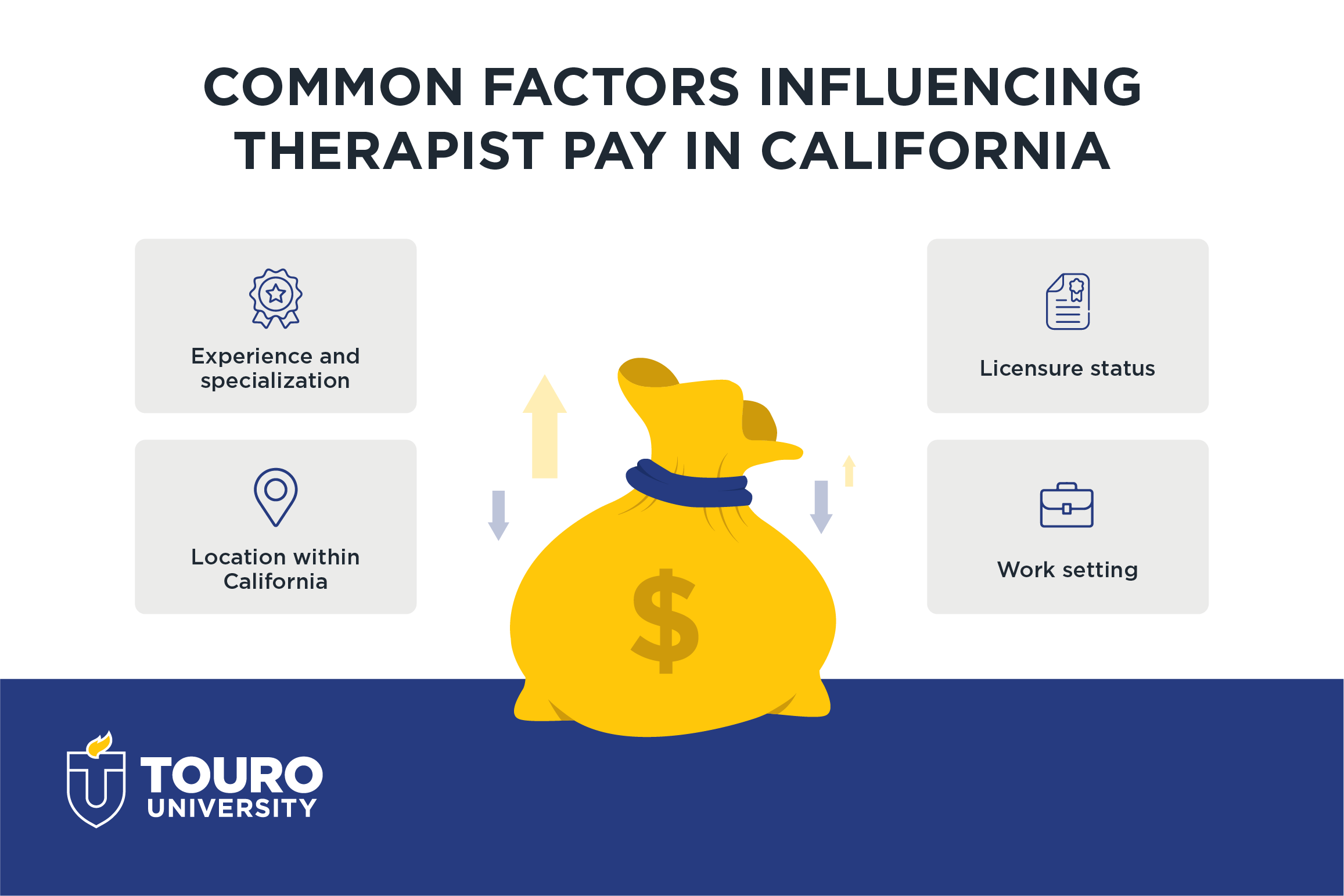
Therapist earnings in California depend on more than job title alone. Licensure status, work setting, location, experience, and area of practice all influence what a therapist can earn, while full licensure expands access to independent practice and a wider range of professional opportunities. Strong demand for behavioral health services also supports a positive outlook for people entering the field.
If you’re considering this career, explore TUW’s online MA in Marriage and Family Therapy, review available financial aid options, and check upcoming start dates through TUW admissions.
Frequently asked questions (FAQs)
How much do associate therapists (AMFTs) make in California?
The BLS does not report separate wage data for pre-licensed associates. AMFTs often earn less than fully licensed clinicians while completing supervised hours, particularly in agency and community mental health settings. Full licensure expands access to independent practice and a broader range of roles, which can increase earning potential. The associate years can be financially challenging, especially while balancing supervision requirements and early-career pay.
Do therapists in private practice make more in California?
They can. Established private-practice therapists can exceed salaried benchmarks, but income depends on factors such as session rates, caseload, location, insurance reimbursement, and business expenses.
Which therapists get paid the most in California?
Among the professions compared here, clinical and counseling psychologists generally have the highest wage benchmarks. They also follow a different education and licensure route that typically requires a doctoral or professional degree. Among master’s-level professions such as LMFT, LPCC, and LCSW, earnings vary considerably by work setting, location, experience, and area of practice.
Is becoming a therapist in California worth it financially?
That depends on your education costs, current income, career goals, and the type of work you plan to pursue. The employment outlook is strong: the BLS projects 17% growth for substance abuse, behavioral disorder, and mental health counselors and 13% growth for marriage and family therapists from 2024 to 2034. Flexible online study can also make it easier for working adults to continue working while completing their education.
How long until I earn a full therapist salary in California?
There is no fixed timeline. For LMFT licensure, California requires a qualifying graduate degree and 3,000 hours of supervised experience completed over at least 104 weeks. Up to 1,300 of those hours may be completed before the degree is awarded, so the total time depends on your program, how quickly you accumulate qualifying hours, and when you complete the examination and licensing requirements.