


LMFT Salary in California: What Therapists Earn in 2026
Key takeaways
- California employs about 34,970 marriage and family therapists, while BLS projects employment in the occupation to grow 14% nationally from 2025 to 2035, much faster than the average for all occupations.
- Marriage and family therapist pay varies considerably by location and work setting. California metro medians range from about $49,610 in San Diego to $95,110 in San Jose, while BLS wage data excludes self-employed therapists.
- Touro University Worldwide’s online Master of Arts in Marriage and Family Therapy includes a California BBS-approved Marriage and Family Therapy track designed to meet the educational requirements for California LMFT licensure.
California marriage and family therapists earn a median annual wage of $67,300, slightly above the national median of $66,940, according to the U.S. Bureau of Labor Statistics.
For current and aspiring MFTs, AMFTs completing supervised experience, and career changers considering the profession, salary can vary considerably by location, work setting, and career stage. Reviewing statewide and local wage data can provide a clearer picture of earning potential in California, along with how MFT pay compares with other clinical professions.
How much do LMFTs make in California?
BLS OEWS data puts the median annual wage for California marriage and family therapists at $67,300. The lowest 10% earn less than $46,350, while the highest 10% earn more than $130,340.
| Annual wage (BLS OEWS) | California | United States |
|---|---|---|
| 10th percentile | $46,350 | $44,650 |
| Median (50th percentile) | $67,300 | $66,940 |
| 90th percentile | $130,340 | $123,730 |
These figures represent employed marriage and family therapists. BLS OEWS data does not include self-employed workers, so earnings from self-employed private practice are not reflected in the wage estimates.
California employs about 34,970 marriage and family therapists, while nationally, employment in the occupation is projected to grow 14% from 2025 to 2035. BLS also projects about 6,900 openings each year over that period.
What affects LMFT pay in California

LMFT pay in California can vary by location, work setting, experience, and licensure status. The statewide median provides a useful benchmark, but it does not reflect the full range of salaries across employers and regions. BLS wage data also excludes self-employed workers, so earnings from independent private practice are not included.
Licensure can impact employment and earning opportunities
BLS does not publish separate wage data for Associate Marriage and Family Therapists (AMFTs) and licensed LMFTs, so there is no reliable government salary comparison between the two groups.
Licensure does, however, affect the types of work a therapist can perform independently. AMFTs complete supervised experience toward licensure, while LMFTs can provide services independently within their scope of practice. Some employers and insurance networks may also require full licensure, which can affect the positions available to a therapist.
California requires 3,000 hours of supervised professional experience over at least 104 weeks for LMFT licensure. TUW’s MFT program includes six clinical practicum courses completed over one year, providing at least 300 direct client-contact hours and 100 hours of MFT relational/systemic supervision as part of the degree. These practicum requirements are separate from the full supervised-experience requirements for California licensure.
Your metro area can affect pay
Pay for marriage and family therapists varies considerably across California metro areas. BLS data shows a median annual wage of $95,110 for marriage and family therapists in San Jose, compared with $49,610 in San Diego.
| Metro area (21-1013) | Median annual wage | Employment |
|---|---|---|
| San Jose-Sunnyvale-Santa Clara | $95,110 | 1,180 |
| San Francisco-Oakland-Fremont | $77,210 | — |
| Sacramento-Roseville-Folsom | $75,030 | 1,380 |
| San Diego-Chula Vista-Carlsbad | $49,610 | 5,350 |
San Jose, San Francisco, and Sacramento all have median wages above the statewide median of $67,300, while San Diego falls below it. San Diego also has a larger published employment estimate than San Jose and Sacramento, with 5,350 marriage and family therapists. BLS does not publish an employment estimate for San Francisco in this dataset.
Government roles pay most
National BLS data shows differences in median pay by industry for marriage and family therapists. State government roles, excluding education and hospitals, have a median annual wage of $92,150, followed by outpatient care centers at $75,560, offices of other health practitioners at $64,430, and individual and family services at $61,060.
These figures are national industry medians rather than California-specific estimates, but they show how work setting can affect pay. BLS also notes that its wage data does not include self-employed workers, so earnings from independent private practice are not reflected in these figures.
Private-practice income can vary based on factors such as session rates, caseload, insurance participation, and business expenses, so there is no single BLS wage figure for self-employed LMFTs.
LMFT vs. LCSW, LPCC, and psychologist salaries in California
The figures below use BLS state occupational wage data for California.
| License (closest BLS category) | California median annual wage |
|---|---|
| LMFT (marriage and family therapists) | $67,300 |
| LPCC (substance abuse, behavioral disorder, and mental health counselors) | $59,250 |
| LCSW (mental health and substance abuse social workers) | $79,000 |
| Licensed psychologist (clinical and counseling psychologists) | $116,000 |
Clinical and counseling psychologists have the highest median wage among these occupational categories, but becoming a licensed psychologist generally requires doctoral-level education. For the master’s-level routes, salary is only one consideration because scope of practice, work setting, specialization, and career goals also differ.
Students interested in meeting the educational requirements for both LMFT and LPCC licensure in California can consider our Counseling Licensure Track. The 82-credit track is approved by the California BBS and is designed to meet the educational requirements for both licenses.
How to increase your LMFT salary in California
There is no single step that guarantees a higher LMFT salary, but licensure, work setting, additional responsibilities, and private practice can affect the opportunities available over time.
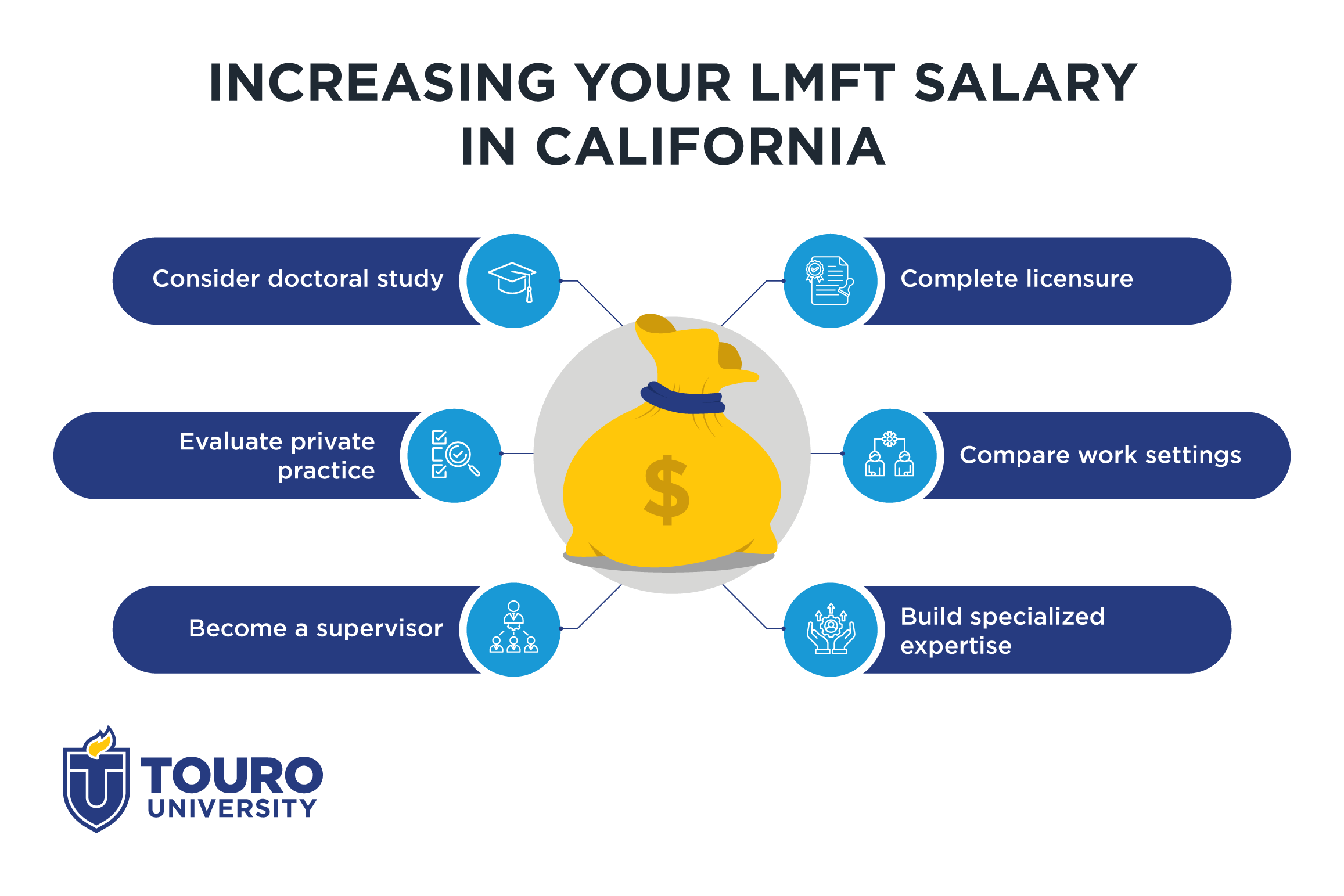
- Complete the licensing process efficiently: California requires 3,000 supervised hours over at least 104 weeks. Post-degree hours may count under the state’s 90-day rule when the applicable BBS requirements are met, so keeping registration and supervision documentation organized can help prevent avoidable delays.
- Consider work settings with higher reported wages: National BLS data shows higher median wages for marriage and family therapists in state government and outpatient care centers than in several other major industries.
- Develop expertise relevant to your work: Additional training in areas connected to your clients, setting, or career goals can expand the types of services you are prepared to provide.
- Consider becoming a qualified supervisor: Experienced LMFTs who meet California’s supervisor requirements may supervise MFT trainees and associates, adding another professional responsibility to their work.
- Evaluate private practice carefully: BLS does not report earnings for self-employed therapists. Income can depend on session rates, caseload, insurance participation, and business expenses.
- Consider doctoral education for advanced professional goals: A doctorate may support goals in areas such as supervision, administration, education, research, or clinical leadership.
TUW’s Doctorate of Marriage and Family Therapy develops advanced competencies in areas such as supervision, leadership, education, research, and program development. The degree does not itself lead to licensure or certification.

Final thoughts on LMFT salary in California
California marriage and family therapists earn a median annual wage of $67,300, with pay varying by location, work setting, experience, and employment arrangement. Licensure also affects the types of positions and independent practice opportunities available to therapists as their careers progress.
For those preparing to enter the field, our online Master of Arts in Marriage and Family Therapy provides the graduate education required to begin the California LMFT licensure process. Students can review current tuition and contact admissions for program and application information.
Frequently asked questions (FAQs)
Can LMFTs make six figures in California?
Yes. BLS data for California marriage and family therapists places the 90th percentile at $130,340, indicating that some employed therapists earn six-figure salaries. Actual pay varies by location, setting, experience, and other factors.
Who gets paid more in California, an LMFT or an LCSW?
Using the closest BLS occupational categories, mental health and substance abuse social workers have a California median wage of $79,000, compared with $67,300 for marriage and family therapists. These categories are broader than the LCSW and LMFT licenses themselves, so they should be treated as general comparisons.
How much do private-practice LMFTs make in California?
There is no single BLS salary figure for private-practice LMFTs because OEWS wage data excludes self-employed workers. Earnings can vary considerably based on session rates, caseload, insurance participation, business expenses, and the number of hours worked.
How much does Kaiser pay LMFTs in California?
Pay varies by position and location. A 2026 Kaiser Permanente posting in Santa Clara for a licensed mental health therapist role that accepts California LMFTs listed a base pay range of $57.77 to $64.52 per hour. Current applicants should check individual job postings for the applicable range.
Is becoming an LMFT worth it in California?
It depends on your career goals and the time and cost required for licensure. BLS projects employment for marriage and family therapists to grow 14% nationally from 2025 to 2035, while California licensure permits qualified LMFTs to practice independently after completing the state’s education, supervised experience, and examination requirements.